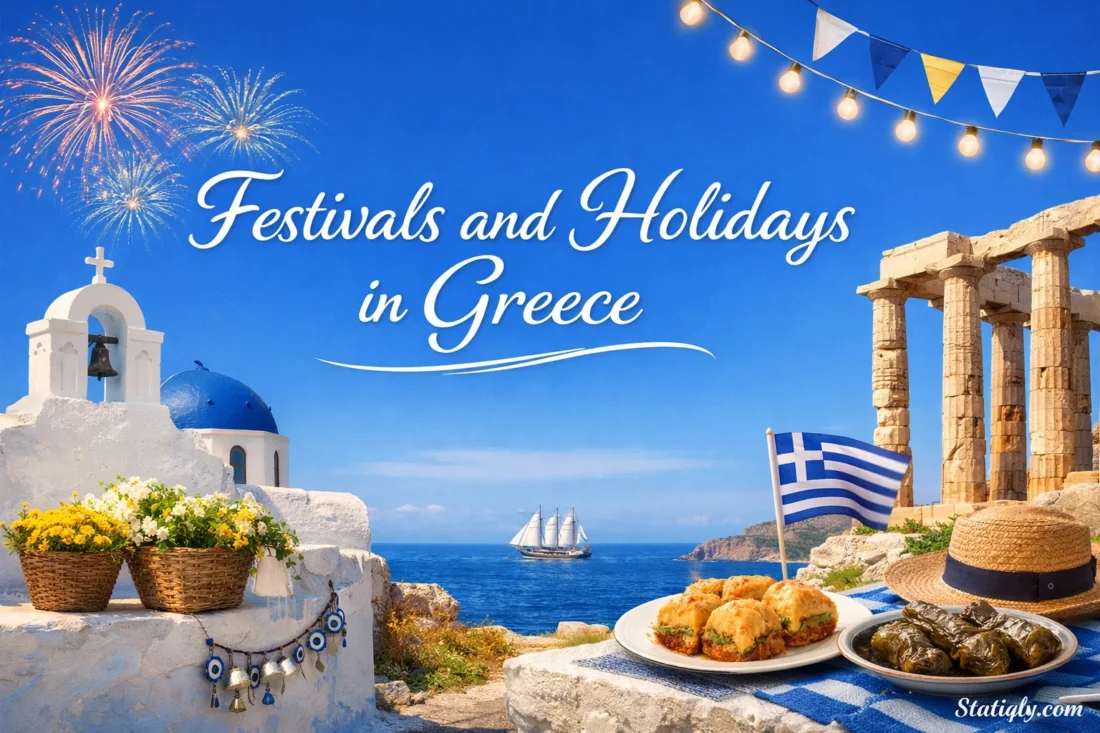
Few countries live through their calendar the way Greece does. Here, holidays are not small pauses between ordinary days. They move into streets, village squares, harbours, churchyards, and family tables. A brass band passes, children sing at the door, candles glow at midnight, kites rise over a windy hill. That is the rhythm. Some dates are official public holidays across the country. Others are local feasts that make one town, one island, or even one neighbourhood feel suddenly full and awake.
When The Greek Year Feels Most Alive
| Celebration | Usual Time | What Stands Out |
|---|---|---|
| Christmas And New Year | Late December to 1 January | Carols, festive sweets, family meals, vasilopita |
| Epiphany | 6 January | Church services and the Blessing of the Waters |
| Carnival And Clean Monday | Late winter, moving dates | Masks, parades, kite flying, outdoor meals |
| Greek Orthodox Easter | Spring, moving dates | Processions, candles, red eggs, long family gatherings |
| Summer Panigiria | Mainly June to August | Village feasts, music, dancing, saint’s day traditions |
| Athens And Epidaurus Festival | Summer | Theatre, music, and dance in historic venues |
| Thessaloniki International Film Festival | November | Cinema screenings and city-wide cultural energy |
The Celebrations That Shape The Year
In Greece, the calendar does more than mark time. It gathers people. One season leans into the next, and each one carries its own sound, food, and feeling. Some celebrations are quiet and family-based. Others fill whole cities. Want to understand Greece beyond beaches and ruins? Look at the festive calendar. It tells you how people meet, eat, remember, and enjoy being together.
Christmas, New Year, And Epiphany
The winter holiday season in Greece feels warm, even when the weather is cool. On Christmas Eve and New Year’s Eve, children often go from house to house singing carols. Bakeries and homes fill with seasonal sweets, especially melomakarona and kourabiedes. Then comes one of the most loved family moments of the season: the cutting of vasilopita, the New Year cake or bread with a hidden coin inside. Whoever finds the coin gets the year’s lucky slice. Small custom, big smile.
The season closes with Epiphany on 6 January. In many places, especially near the sea, rivers, or lakes, a cross is thrown into the water during the blessing ceremony and swimmers dive in to retrieve it. It is one of those Greek scenes that stays in the mind: winter light, church bells, cold water, and a crowd gathered close.
- Christmas brings carols, sweets, decorated homes, and long meals with family.
- New Year centres on luck, fresh beginnings, and the cutting of vasilopita.
- Epiphany adds a public ritual that links faith, community, and the sea.
Carnival And Clean Monday
Before Lent begins, Greece turns playful. The carnival season, known as Apokries, brings costumes, street events, music, and a lighter public mood. You see it in big cities and small towns, but some places are especially well known. Patras Carnival is the country’s best-known carnival celebration, with major parades, children’s events, and a long season of public festivity. Xanthi is known for folk art festivities and large crowds. Naousa keeps older masquerade customs alive in a more traditional way.
The shift comes with Clean Monday, the first day of Lent. Families and friends head outdoors for Koulouma, fly kites, and eat meat-free dishes. The table is simple, but never dull: lagana bread, olives, salads, seafood, pulses, and halva appear again and again. It is a very Greek kind of holiday mood—open air, shared food, easy conversation, and enough wind to keep the sky busy.
- Patras is the best-known carnival city in Greece.
- Xanthi blends carnival with folk art events and concerts.
- Clean Monday is widely linked with kite flying, outdoor meals, and the start of Lent.
Greek Orthodox Easter
If one celebration sits at the heart of the Greek festive year, it is Greek Orthodox Easter. The date often differs from Western Easter, and the build-up matters just as much as the day itself. During Holy Week, churches fill, town centres slow down, and the tone becomes more reflective. On Good Friday, flower-covered Epitaphios processions move through streets and squares. On Holy Saturday near midnight, candlelight passes from person to person until a dark church or square glows from hand to hand. Then the mood changes fast. Joy arrives all at once.
Easter Sunday is for long meals, family visits, music, and red eggs cracked at the table. In many parts of Greece, lamb is prepared for the feast. Regional Easter customs are part of the appeal too. Corfu is famous for its bands and Holy Week atmosphere. Patmos, Chios, and Leonidio are also widely known for memorable Easter celebrations. You do not just watch Easter in Greece. You step into it.
- Good Friday is linked with processions and floral decoration.
- Holy Saturday centres on candlelight and the midnight Resurrection service.
- Easter Sunday is social, family-focused, and deeply tied to the shared table.
Summer Panigiria And Open-Air Arts Festivals
Summer in Greece has two festive tracks at once. One is local and traditional. The other is cultural and city-facing. The traditional side appears in the many panigiria, village and island feasts usually linked to a saint’s day. These gatherings bring live music, dancing, shared food, and a strong sense of place. They are not polished for show. That is why people love them.
One summer date stands out across the country: 15 August, the Assumption of the Virgin Mary. In many towns and islands, the day comes with church services and evening feasts. For locals, it often feels like one of the year’s biggest summer gatherings.
The cultural side of summer appears in events such as the Athens And Epidaurus Festival. Every summer, audiences gather for theatre, music, and dance performances, including shows in historic venues. The Epidaurus setting gives the experience its own weight. Open sky above, ancient stone around, performance at the centre. Simple scene. Hard to forget.
- Panigiria are among the best ways to see local music and dance traditions still in use.
- 15 August is one of summer’s most widely marked feast days.
- Athens And Epidaurus Festival gives summer in Greece a strong theatre and music season.
Autumn Festivals In The Cities
Once summer fades, the festive calendar does not shut down. It changes shape. Thessaloniki International Film Festival, held every November, brings a different kind of gathering: screenings, discussion, and a city that starts to move around cinema. Thessaloniki also hosts its documentary festival in March, which shows how Greek festival culture stretches well beyond summer and well beyond the island season.
That matters for travellers. Greece is not only festive when the beaches are full. City breaks in spring and autumn can line up with major cultural events, and the atmosphere can feel more local, more relaxed, and easier to enjoy at street level.
Official Public Holidays In Greece
For practical planning, it helps to separate popular celebrations from the nationwide public holidays set out in official guidance. These dates shape opening hours, transport patterns, and the general pace of the day. Local authorities may also add local public holidays, so smaller places can follow their own calendar too.
- 1 January — New Year’s Day
- 6 January — Epiphany
- 25 March — Public holiday observed nationwide
- Easter Monday — Moving date
- 1 May — Labour Day
- 15 August — Assumption of the Virgin Mary
- 28 October — Public holiday observed nationwide
- 25 December — Christmas Day
- 26 December — Boxing Day
Beyond that list, many people also plan around Clean Monday and the days of Holy Week, because the social and cultural weight of those days is much bigger than an ordinary week on the calendar.
What Makes Greek Festivals Feel Different
Greek celebrations often feel public and personal at the same time. A holiday may begin in church, continue in the square, and end at a family table. A city festival may bring international artists, but it still feels tied to local space and local habit. Even food carries the date: lagana on Clean Monday, red eggs at Easter, vasilopita at New Year, sweets through Christmas. The meal is not separate from the day. It is part of the day.
There is also strong regional character. One island keeps one Easter custom, a northern town keeps another carnival tradition, a mountain village gathers for a saint’s day feast that outsiders may only hear about by chance. That variety is part of the charm. Greece has national holidays, yes. Still, many of its most memorable festive moments are local.
Useful Timing Notes For Visitors
- Book early for Easter, major carnival weekends, and mid-August travel.
- Check local opening hours for museums, shops, and archaeological sites around public holidays.
- Look for town or island panigiria if you want a more local summer evening.
- Expect crowds in famous places such as Corfu at Easter and Patras during carnival.
- Do not assume every celebration is fixed-date; Carnival, Clean Monday, Easter, and other related days move each year.
Festive Places Many People Seek Out
- Patras for the country’s most famous carnival season
- Xanthi for carnival with a folk art feel
- Naousa for older masquerade customs
- Corfu for Holy Week and Easter atmosphere
- Patmos, Chios, And Leonidio for well-known Easter celebrations
- Epidaurus for summer performances in a historic theatre setting
- Thessaloniki for film festival season in autumn and spring