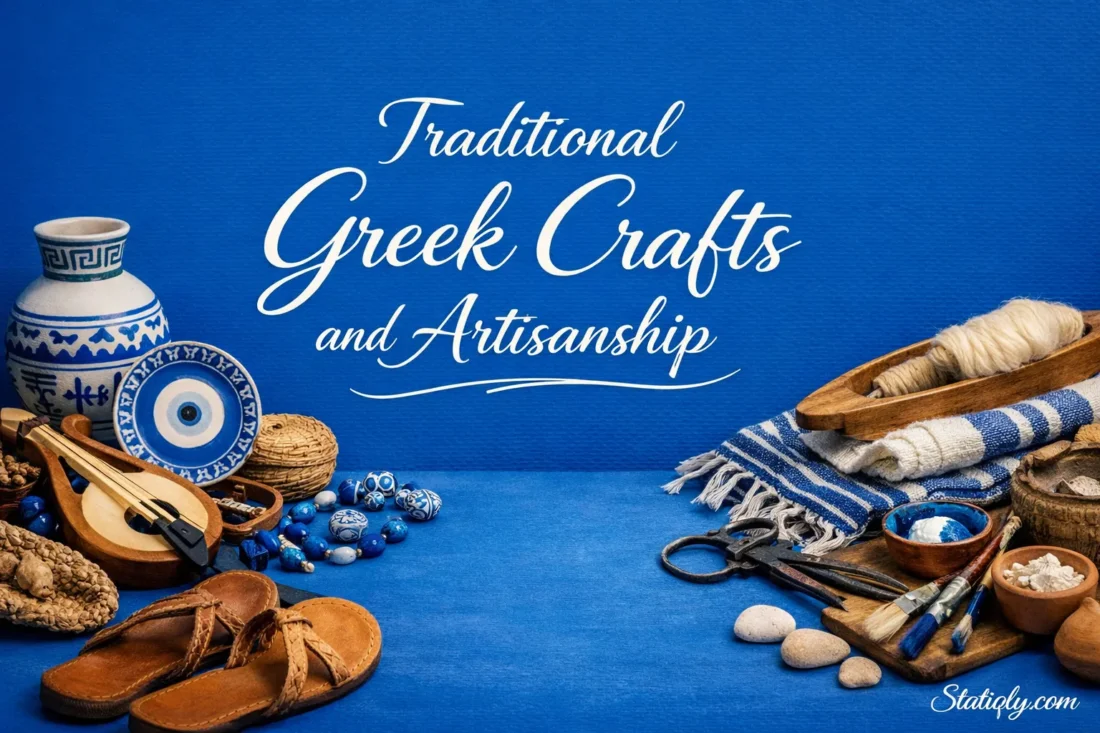
Greek craftsmanship is easiest to understand with your hands and eyes, not with grand words. A carved marble lintel in Tinos, a silver bracelet from Ioannina, a silk scarf from Soufli, a woven textile from an island workshop; each one carries a quiet kind of memory. That is what makes traditional Greek crafts so engaging. They are not only objects. They are habits of making, local knowledge, and daily patience turned into form. Look closely and the story appears in the grain of wood, the pull of thread, the shine of hammered metal, the cool surface of stone. Small details matter here. They always did.
| Craft | Place Often Linked With It | What Stands Out | Why It Matters |
|---|---|---|---|
| Marble Carving | Tinos, especially Pyrgos | Door lintels, fountains, relief motifs, workshop skill | It joins material knowledge, village identity, and long workshop practice |
| Silversmithing | Ioannina and Epirus | Hand-shaped and hand-decorated silver objects | It shows how precision and ornament can live in the same piece |
| Silk Work | Soufli | Sericulture, thread making, weaving, dyed fabric | It connects farming, making, and textile culture in one chain |
| Pottery and Ceramics | Naxos and workshops across Greece | Useful forms, clay character, restrained decoration | It keeps everyday craft close to daily life |
| Embroidery and Weaving | Mainland villages and islands | Geometric, floral, and symbolic motifs | It carries dress, household memory, and regional taste |
| Woodcarving and Icon Painting | Churches, monasteries, homes, local studios | Carved wood, painted panels, fine hand control | It keeps visual language, devotion, and craft discipline alive |
Why Greek Handwork Feels So Distinct
Many countries have old craft traditions. Greece stands out for a simpler reason: the material and the place stay close to each other. Stone belongs to the island landscape. Silver belongs to workshop towns with a long making culture. Silk belongs to a town that built part of its identity around thread. Cloth, wood, and clay stay tied to homes, clothing, storage, worship, and celebration. The object does not float away from life. It stays near it.
That closeness shapes the look of the work. Greek artisans often value balance over excess, clarity over noise, touch over polish. Even when a piece is ornate, it rarely feels careless. Every line has to earn its place. In a good handmade object, nothing is lazy. Not the edge. Not the back. Not the handle. Not the join.
Marble on Tinos and the Language of Stone
Tinos, and especially the village of Pyrgos, holds a special place in Greek marble work. Tinian marble craftsmanship entered UNESCO’s Representative List in 2015, and that recognition makes sense the moment you see how deeply the craft lives in the built environment. This is not stone used only for monuments. It appears in doors, fountains, family signs, shrines, cemetery pieces, and workshop models. Stone becomes part of daily sight.
What makes Tinos memorable is not only the finished carving. It is the full chain behind it: quarrying, cutting, sketching, chiseling, smoothing, fitting. Old motifs still appear in the visual language of the craft, including cypresses, flowers, birds, and ships. Some are decorative. Some carry symbolic weight. All of them show that marble in Greece is more than raw material. It is a language learned by hand.
And there is something else. Marble can feel cold in theory, yet in Tinos it often feels human. You notice the rhythm of the chisel. You see where the maker slowed down. You see where the stone asked for respect. That is artisanship in its clearest form: not forcing the material, but reading it.
- Look for carved lintels above doors and windows.
- Notice how relief motifs sit within the surface instead of fighting it.
- Pay attention to workshop traces on less visible parts of a piece.
- When possible, compare a finished work with tools or models in a museum setting.
Silver in Ioannina and the Discipline of Detail
Ioannina is one of the names most closely linked with Greek silversmithing. The local museum dedicated to the craft presents the history and technology of Epirote silver work and shows how silver objects were shaped and decorated across the stages of making. That matters, because silver can be misunderstood. People often see only shine. The real craft sits in pressure, timing, and control.
A fine silver object asks for a steady hand and a calm eye. Ornament, when done well, does not feel crowded. It breathes. The line turns. The edge holds. The whole piece keeps its balance. In Ioannina, silverwork has been tied not only to jewellery but also to household objects and personal items, which gives the tradition a wider social life. It was not made for a single shelf or one special room. It moved through ordinary life too.
What should a visitor notice first? The finish is only one clue. Better clues are these: the sharpness of repeated patterns, the confidence of small engraved details, the way decorative work respects the form underneath. Tiny choices reveal the maker. Loud display does not.
Silk in Soufli and the Full Journey of a Thread
Soufli is often called the silk town of Greece, and not by accident. Its craft story is broad, because silk is never just one action. It starts with sericulture, moves into unwinding and processing, then continues through dyeing and weaving. In other words, silk in Soufli is not only textile work. It is a chain of skills.
The local Silk Museum presents the stages of pre-industrial sericulture and silk manufacture and explains how Soufli grew into a major silk-production center from the late nineteenth century into the middle of the twentieth. That historical line still shapes the town’s character. Workshops, textiles, local memory, and built space still speak to one another.
Silk has its own kind of drama, though a quiet one. Marble resists. Silver reflects. Silk flows. It shifts with light, catches dye differently, and asks for care at every step. So when you hold a well-made Greek silk item, you are not holding a single craft gesture. You are holding several.
- Notice the surface before you notice the color.
- Look for an even but not lifeless weave.
- Ask whether the piece feels made to wear and use, not only to display.
- When a workshop explains process clearly, that is usually a good sign.
Pottery, Weaving, and Embroidery in Daily Life
Some Greek crafts live most powerfully in the home. Pottery, weaving, and embroidery belong to that world. They are close to storage, dining, clothing, decoration, and ceremony. That nearness gives them lasting strength. A handmade bowl, a woven textile, an embroidered cloth; these are not distant art forms. They sit where people live.
Pottery and ceramics have a very long history in Greece, and regional variation still matters. On Naxos, local craft identity has been linked with both ceramics and weaving. That pairing is telling. Clay and cloth may seem far apart, yet both depend on rhythm, repetition, and material judgment. One wrong movement changes the whole result.
Greek embroidery often uses geometric, floral, and symbolic motifs. Those patterns are not random decoration. They help carry memory across generations, especially through clothing and household textiles. A stitched border can say more than a long explanation. Sometimes a motif travels from one village to another and changes slightly on the way. Sometimes it stays stubbornly local. That is part of the charm.
Weaving, too, rewards close looking. A good woven piece does not feel flat in the hand, even when the pattern seems simple. It has body. It has direction. It has pace. Small things again, yes. Yet small things are often the whole story in textile craft.
Woodcarving and Icon Painting as Living Workshop Arts
Woodcarving keeps a strong place in Greek visual craft. It appears in furniture, architectural details, and religious objects. The skill lies not only in carving forms out of wood, but in knowing where to stop. Too much carving and the piece becomes restless. Too little and it says nothing. Good work sits in between, alive but controlled.
Icon painting follows a different discipline. Greek icon painters work on wooden panels and use materials such as natural pigments and egg tempera. The process is careful and rule-bound, yet the result does not feel mechanical. That is the interesting part. Repetition does not erase individuality; it refines it. In a strong icon, restraint becomes expression.
These two crafts also show something broader about Greek artisanship: the line between art and use is often softer than people expect. A carved panel can hold beauty and purpose at the same time. So can a painted icon. So can a silver cup. So can a woven coverlet. Greek making has room for both grace and function, and it rarely feels forced.
How to Read a Handmade Greek Object
How can you tell whether a piece carries real workshop care? Start with patience. Then look beyond the front-facing charm.
- Turn it around. The back, underside, or inner edge often tells the truth faster than the front.
- Watch for controlled variation. Handmade work usually shows slight difference, not sloppy difference.
- Ask about process. A good seller or maker can usually explain material, method, and place without vague talk.
- Check the fit between decoration and form. The pattern should belong to the object, not sit on it like an afterthought.
- Notice wearability or usability. A bracelet should feel balanced. A bowl should feel comfortable to hold. A textile should move well.
- Look for local character. Motifs, materials, and making habits often reveal where the piece comes from.
What Gives Greek Craft Its Staying Power
Three things keep returning in Greek craft traditions. First, material intelligence. Makers learn what marble veins allow, how silver responds to hand pressure, how thread behaves under tension, how wood resists the wrong cut. Second, regional memory. A village, a town, an island, a workshop line; all leave marks on form. Third, use. Many of these crafts remain close to real life, which protects them from becoming empty display.
This is why Greek artisanship still speaks clearly to visitors today. It does not depend on museum language alone. You can read it in buildings, shops, workshops, church interiors, household textiles, market pieces, and small regional museums. Sometimes the most honest lesson comes from a modest object on a shelf. A carved spoon. A stitched panel. A simple ceramic plate. Nothing grand. Everything learned.
Places Where You Can See Process, Not Just Product
- Pyrgos, Tinos: a strong place to understand marble tools, motifs, and the workshop culture around stone.
- Ioannina: ideal for seeing how silver objects are shaped, decorated, and placed within regional craft history.
- Soufli: one of the best places to follow silk from cocoon to woven fabric.
- Naxos: helpful for visitors curious about the connection between ceramics, weaving, and island craft identity.
- Local folk and costume museums across Greece: useful for reading embroidery, woven textiles, dress details, and household making traditions.
For travelers, that makes a real difference. You do not need to guess what a craft means when you can see its tools, materials, and regional setting side by side. The object becomes clearer, and so does the hand behind it.
Choosing a Piece That Feels True to Place
If you want to take home a handmade piece from Greece, slow down before buying. Ask where it was made. Ask what material was used. Ask who made it, or where the workshop is. These are simple questions, yet they change the whole experience. A piece with a clear local story usually keeps its value in a deeper way. Not only as an object, but as a memory you can still read years later.
The most rewarding choices are often the least noisy: a carved marble detail small enough to study closely, a silver object whose decoration stays disciplined, a silk textile with real texture, a ceramic vessel that feels right in the hand, an embroidered cloth whose pattern seems quiet at first and better the longer you look. That is how Greek craft often works. It does not rush toward you. It waits. Then it stays.