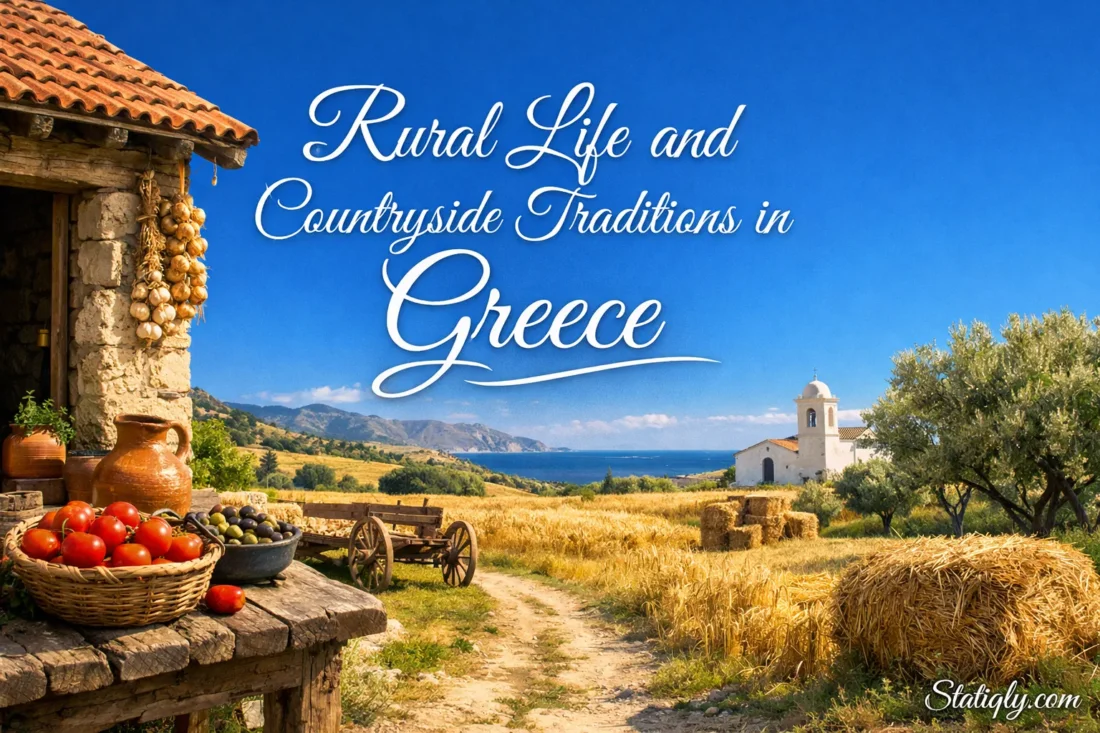
Why does rural Greece stay with people so easily? Part of the answer sits in the land itself. Mountains, island slopes, olive groves, pasture routes, village squares, and family kitchens all pull in the same direction. In the Greek countryside, daily life still follows the seasons in a visible way. Work has its calendar. So do meals, music, feast days, and reunions. Quiet in one hour, full of voices in the next, a village can feel simple at first and layered a moment later.
| Part Of Rural Life | What You Often Notice | How It Shapes Tradition |
|---|---|---|
| The Village Square | A meeting point near the main café, benches, and often the bus stop | Daily conversation, news, and feast-day gatherings all pass through the same shared space |
| Seasonal Work | Olive picking, gardens, shepherding, and household food preparation | The year is felt through work, not just dates on a calendar |
| Built Landscape | Stone houses in mountain areas, terraces and dry-stone walls on slopes, local craft details in village homes | Homes and fields grow out of the land around them |
| Festive Rhythm | Spring celebrations, summer village feasts, music, dance, and returning family members | Tradition stays social, not distant |
| Local Skill | Weaving, embroidery, basketry, marble work, and food-making knowledge | Useful work becomes a way of keeping memory alive |
How Geography Shapes Daily Life
Greek rural life never looks exactly the same from one region to another. It cannot. A mountain village in Epirus, a farming settlement in Thessaly, and an island village in the Cyclades all live with different ground, weather, distance, and building materials. Yet one thread runs through them all: people adjust their homes, work, food, and celebrations to the place around them. Not the other way around.
Mountain Villages and Stone Settlements
In mountain Greece, villages often sit on slopes and carry the mark of local stone. Zagori, in Epirus, is one of the clearest examples. Its villages are known for stone, wood, and slate, and the wider landscape entered the UNESCO World Heritage List in 2023 as a cultural landscape. That makes sense the moment you picture the area: houses, paths, bridges, pastures, and fields belong to one another. Separate them, and the place stops reading as a whole.
There is a practical side to this beauty, too. Stone keeps appearing because it is there, because it lasts, and because it suits steep ground. Rural Greece can be decorative, yes, but first it is functional. Strong, too, is the habit of building with what the land offers.
Island Countryside and Terraced Land
On many islands, village life bends to slopes, wind, and limited flat ground. Fields are often shaped by terraces and dry-stone boundaries, while villages hold tight to their ridges and hillsides. On Tinos, rural character also lives through craft. In Pyrgos, marble work stands out. In Volax, basket makers still work in view of passing visitors. Elsewhere on the island, olive groves, gardens, trails, and village squares keep daily life close to the land.
Plains, Valleys, and Garden Land
In broader plains and valleys, the countryside opens up. The pace can feel less vertical, more field-based. Orchards, vegetable plots, and larger stretches of cultivated land matter more here, and nearby towns often shape shopping, schooling, and market habits. Still, the village remains the social center. Even when work spreads out across fields, people come back to the same square, the same café, the same feast days.
The Village as a Social World
The Square, the Church, and the Kafeneio
What makes a Greek village feel alive even on a slow weekday? Usually the answer is simple: the main square and the places around it. In many villages, the bus stop sits by the square or near the kafeneio, the traditional coffeehouse. People meet there without planning too much. News moves fast. So do greetings, invitations, and small favors.
This matters because countryside traditions are not kept in one building or saved for one special day. They move through ordinary routines. A name day, a visit from relatives, a tray of sweets, a chair pulled into the shade, a late chat after errands are done — village life is built from these small links.
Family Ties and Shared Work
Rural life in Greece is still closely tied to family networks. Work around the home and field often spreads across generations, and many feast days double as homecomings. UNESCO notes this clearly in the August celebrations of Vlasti and Syrrako, where members of the community return from cities to join the village again. That pattern is easy to recognize elsewhere, too. A village may thin out for part of the year, then suddenly fill with cousins, grandparents, children, music, and food.
The Farming Year
Olive Groves, Gardens, and the Home Table
The olive harvest remains one of the clearest signs of the rural year in Greece. Autumn brings movement to olive lands, and family labor often becomes part of the season’s rhythm. Olive oil is not just another product in village life. It is a household staple, a gift, a point of pride, and part of everyday cooking.
Older rural food habits across Greece centered on vegetables, fruit, olives, olive oil, cheese, and bread. That older pattern still helps explain village cooking now. Meals often stay seasonal and practical. They use what is nearby, what is growing, what has been stored, and what can feed many people well. No fuss needed.
Shepherding and Seasonal Movement
In mountain regions, shepherding has long shaped the countryside. One of the most telling customs is transhumance, the seasonal movement of herders and livestock between different grazing areas. UNESCO describes it as a spring-and-autumn movement along established pastoral routes. That may sound like a narrow farming detail. It is not. It affects the rhythm of the year, the timing of reunions, the use of pastures, and the memory of routes that families and communities know well.
Dry-Stone Skill and Working With the Land
Dry-stone construction is another rural skill that tells you a lot about Greece. The method uses carefully placed stone without binding material. On steep ground, it helps shape terraces, field edges, paths, and retaining walls. UNESCO lists this craft as intangible cultural heritage because it is more than a technique. It is local knowledge in physical form. You can see it in the line of a field, in the curve of a path, in the way a settlement settles into a hillside instead of fighting it.
Festivals That Keep the Countryside Moving
Easter in Villages
Greek Easter is celebrated across the country, but official Greek travel material points out that it is felt in a very traditional way in the countryside and in villages. That sounds right because village Easter is deeply communal. Courtyards open, families gather, candles light up the night, and the square fills with greetings, music, and shared food. It is both intimate and public. Few traditions show the village as a living community more clearly.
Summer Panigyria and August Feasts
The Greek countryside changes tone in summer. Villages brighten, visitors return, and local feasts known as panigyria bring everyone into the same orbit. Around August 15, many villages decorate their streets, stage traditional dances, and hold large gatherings. In Vlasti and Syrrako, UNESCO notes that these festivities grew as annual reunions of pastoral communities before herders moved to winter pasture. So a dance is not just a dance. It can also be a marker in the working year.
Music, Dance, and Local Costume
Rural dance in Greece often happens in a circle, with the community itself forming the shape of the event. In Tranos Choros at Vlasti, dancers of different ages join hands in a large open circle and move to a slow rhythm while singing. In other regions, instruments, steps, and costume details differ. The feeling does not. Young people learn by watching, then joining. First from the side, then in the line.
Craft Traditions That Still Mark Rural Greece
Weaving, Embroidery, and Useful Beauty
Village traditions in Greece are not only about festivals and farming. They also live in handwork. Embroidery, weaving, pottery, and woodwork remain part of Greek folk art, with patterns and methods that change from region to region. What is striking is how often these skills sit between the practical and the decorative. A woven textile, a stitched garment, a carved object, a household piece — each one serves a purpose, yet it also carries local taste, family memory, and a sense of place.
Marble, Basketry, and Place-Based Skill
Tinos offers a clear picture of how craft and countryside fit together. The island is known for marble carving, especially in Pyrgos, where the local craft tradition has deep roots. Volax is known for basket makers. These are not side notes to village life. They help define it. A craft village is not only where things are made. It is where material, technique, and local identity meet in everyday view.
Small Details That Say a Lot
- Local materials shape homes. In many rural areas, stone is not decoration first. It is the natural answer to the place.
- The square still matters. It remains a meeting point for talk, waiting, eating, and gathering.
- The year is seasonal in a visible way. Olive work, herding, gardens, and feast days still give the calendar texture.
- Movement back to the village is part of the tradition. Summer and major feast days often bring families home again.
- Dance is communal, not distant. Many village dances are made to include people, not separate them into performers and viewers.
- Craft belongs to daily life. Weaving, embroidery, marble work, and basketry help villages keep their local character without needing to explain it out loud.