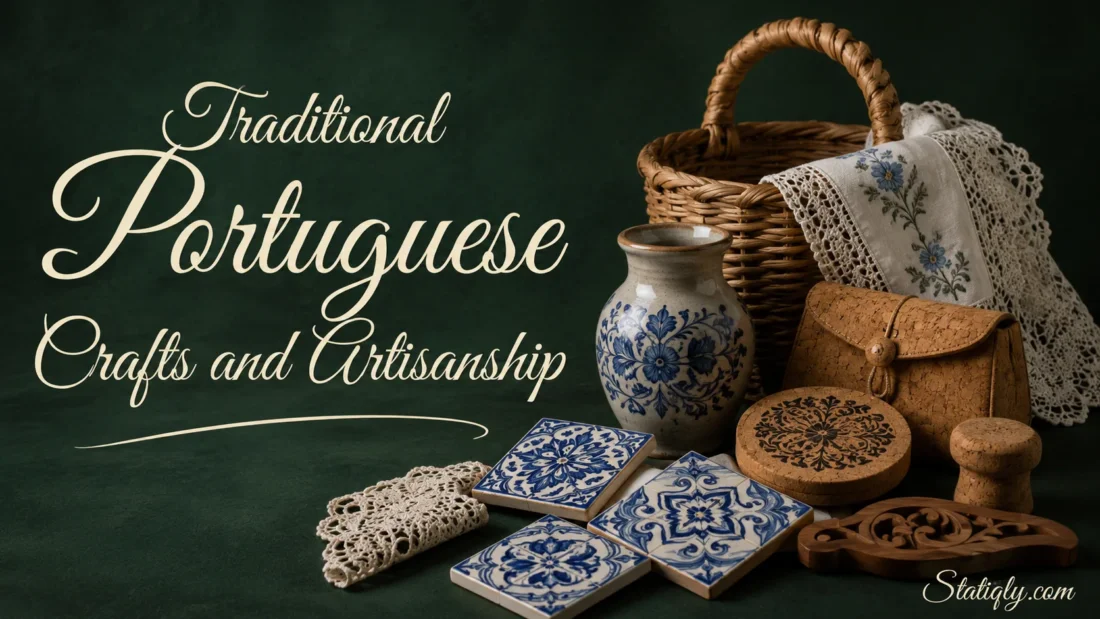
Traditional Portuguese crafts carry the feel of real hands: clay shaped on a wheel, silver wire twisted into fine curves, wool stitched slowly into a rug, cork cut with care from the bark of a living tree. These crafts are not only souvenirs. They are part of daily life, regional identity, and family memory across Portugal. A tile on a wall, a basket in a market, or a small clay figure from Alentejo can tell more about place than a long speech ever could.
Portugal’s craft culture is easy to enjoy because it is visible. You see it on buildings, in small workshops, at local fairs, inside museums, and in family-run shops. Some pieces are made for use. Others are made for beauty. Many do both.
Traditional Portuguese Crafts by Region
The table below gives a clear starting point for the main craft traditions linked with Portugal. Each one has its own materials, pace, and local character.
| Craft Tradition | Places Often Linked With It | Main Materials | What To Notice |
|---|---|---|---|
| Azulejos | Lisbon, Porto, Coimbra, Aveiro, many historic towns | Glazed ceramic tile, mineral pigments | Blue-and-white panels, geometric patterns, hand-painted scenes, building façades |
| Black Pottery | Bisalhães, near Vila Real | Local clay, water, firing earth, smoke | Dark surface, simple forms, handmade finish, cooking and decorative uses |
| Clay Figures | Estremoz, Alentejo | Clay, paint, small hand-modelled details | Bright figures, local dress, trades, animals, rural scenes |
| Filigree Jewellery | Gondomar, Minho, northern Portugal | Gold or silver wire | Fine twisted threads, heart shapes, floral lines, very light metalwork |
| Cork Craft | Alentejo, Algarve, Ribatejo | Cork oak bark | Soft texture, low weight, natural grain, practical objects |
| Arraiolos Rugs | Arraiolos, Alentejo | Wool thread, linen or jute base | Embroidered stitches, floral and geometric patterns, calm symmetry |
| Embroidery And Lace | Madeira, Castelo Branco, Peniche, Vila do Conde | Linen, cotton, silk, thread | Fine stitching, whitework, coloured silk motifs, bobbin lace |
| Basketry | Rural areas across Portugal | Willow, reed, cane, chestnut strips | Light woven forms, market baskets, storage pieces, farm use |
Why Portuguese Craft Feels So Personal
Portuguese artisanship often begins with a local material. Clay comes from nearby soil. Cork comes from the cork oak landscapes of the south and center. Wool, linen, reed, cane, and wood come from work shaped by climate and need. The result feels grounded. Nothing is floating away from its place.
A handmade object in Portugal is rarely only decorative. Tiles protect walls as they decorate them. Cork is light, warm, and useful. Rugs soften homes. Baskets carry bread, fruit, tools, or flowers. Beauty, here, often has a job.
That practical side gives Portuguese crafts their quiet charm. They do not need loud praise. Pick up a cork object, turn over a ceramic bowl, or trace the edge of a hand-painted tile with your eyes. The care is there.
Azulejos: Ceramic Tiles With a Public Voice
Azulejos are one of Portugal’s most recognized art forms. These glazed ceramic tiles appear on churches, train stations, homes, gardens, stairways, fountains, and shopfronts. In many Portuguese towns, the street itself feels like an open-air tile gallery.
The National Tile Museum in Lisbon traces glazed tile production from the late fifteenth century to the present. That long timeline matters. Azulejos changed with taste, technique, and place. Some panels show floral repeats. Some tell stories. Others use simple blue patterns that make a wall feel cool and calm under bright sun.
What Makes Azulejos Special
- They connect art and architecture. A tile panel is not just hung on a wall; it becomes part of the building.
- They are made to last. Glazing helps protect the surface and keeps colour visible for many years.
- They work in small and large forms. A single tile can be beautiful, yet a full wall panel can feel like a visual story.
- They are easy to recognize. Blue-and-white tiles are common, but Portuguese tilework also uses yellow, green, manganese, and many other tones.
For a visitor, azulejos teach a useful lesson: Portuguese craft is not hidden away. It lives outside, facing the street.
Portuguese Pottery and Ceramics
Clay has a long life in Portuguese homes. Bowls, pitchers, plates, jars, oven dishes, tiles, and figures all come from the same honest material: earth, water, hand, fire.
Different regions use clay in different ways. Some pottery is bright and playful. Some is plain and useful. Some carries painted birds, flowers, fruit, fish, or rural motifs. Good handmade pottery does not look perfectly machine-made. That is part of the appeal. A small uneven line may show where the hand moved.
Bisalhães Black Pottery
Bisalhães black pottery comes from a village near Vila Real in northern Portugal. It is known for its dark colour, simple shapes, and traditional firing method. The pieces are made from clay, shaped by hand, then fired in a way that gives them a black surface.
The craft is listed by UNESCO as intangible cultural heritage in need of safeguarding. That does not make it distant or museum-only. It remains a living practice, tied to local identity and daily memory.
Black pottery works well as a reminder that Portuguese craft is not always bright. Sometimes it is quiet, dark, and earthy. Still beautiful.
Estremoz Clay Figures
Estremoz clay figures are small, colourful, and full of local detail. This Alentejo craft dates back to the seventeenth century. The figures often show rural life, animals, trades, regional clothing, and familiar scenes from local culture.
Each figure begins as clay. Then come the tiny details: a face, a basket, a hat, a tool, a dress, a flower. The scale is small, but the work asks for a steady hand. Too much force, and the form loses its character.
These figures show how folk art can keep everyday life visible. Not grand. Not distant. Close to the ground.
Filigree Jewellery: Metal Worked Like Lace
Portuguese filigree turns gold or silver into fine twisted threads. Artisans bend, curl, and join the wire into light designs. The result can look delicate, yet it needs control, patience, and heat at just the right moments.
Gondomar, near Porto, is one of the best-known centres for this craft. Northern Portugal is also closely linked with filigree jewellery, especially heart-shaped pendants and floral forms. The pieces often appear in earrings, necklaces, brooches, and traditional dress ornaments.
How To Recognize Good Filigree
- Look for fine, even wirework rather than heavy stamped decoration.
- Check the lightness of the piece; true filigree often feels airy.
- Notice the joins. Careful soldering should not overpower the pattern.
- Ask where it was made and whether it comes from a workshop or artisan producer.
Filigree is a good example of a craft that looks soft but depends on discipline. Like drawing with metal, it asks the hand to stay calm.
Cork Craft: Portugal’s Lightest Natural Material
Portugal is one of the world’s main cork producers, and cork craft is closely tied to the cork oak landscapes of Alentejo, Algarve, and other regions. Cork comes from the bark of the cork oak tree. The tree is not cut down during proper harvesting, which makes the material highly valued for repeated use.
Traditional cork was long linked with stoppers, insulation, and rural uses. Today, artisans and small makers also turn it into bags, wallets, notebooks, mats, coasters, trays, lampshades, and decorative objects.
Why Cork Works So Well for Craft
- It is light. A cork object is easy to carry and handle.
- It has a soft touch. The surface feels warm rather than cold.
- It has natural patterning. Every piece shows slight changes in grain and tone.
- It suits daily use. Cork can work in homeware, fashion accessories, and desk items.
Cork is simple at first glance. Then you notice how much it can do.
Arraiolos Rugs and Textile Traditions
Arraiolos rugs come from the Alentejo town of Arraiolos. They are embroidered rather than knotted. Artisans work wool thread onto a base, often using a diagonal stitch associated with the craft.
The patterns can be floral, geometric, or medallion-based. Many feel balanced and calm, with repeated forms that guide the eye without noise. These rugs suit the slow pace of handwork. They cannot be rushed without losing their soul.
Embroidery, Lace, and Fine Threadwork
Portugal also has strong traditions of embroidery and lace. Madeira embroidery is known for fine whitework and elegant stitching. Castelo Branco embroidery often uses silk thread on linen, with birds, flowers, trees, and flowing motifs. Bobbin lace traditions are linked with places such as Peniche and Vila do Conde.
Threadwork rewards close looking. A tablecloth, blouse detail, handkerchief, or lace edge may seem simple from across the room. Up close, the hours appear.
Basketry, Woodwork, and Rural Craft
Not every Portuguese craft belongs in a display case. Many began in fields, kitchens, markets, boats, farms, and homes. Basketry is one of the clearest examples.
Artisans use materials such as willow, reed, cane, and chestnut strips to make baskets for carrying, storing, and sorting. Shapes change by region and use. A market basket may need strength. A bread basket may need air. A farm basket may need a wide mouth and firm base.
Woodwork also appears in household objects, tools, toys, decorative carvings, and furniture details. In rural craft, design often follows need first. Then beauty slips in through proportion, texture, and finish.
How Portuguese Artisans Learn Their Skills
Many crafts pass through families, workshops, local schools, associations, and town traditions. The learning is practical. Watch first. Try slowly. Make mistakes. Repeat. Again.
An artisan may spend years learning how clay behaves, how thread tension changes a stitch, or how metal reacts to heat. That knowledge is hard to write down fully. It lives in the fingers as much as in the mind.
This is why a handmade object carries more than form. It carries judgment. The maker decides when the clay is ready, when the stitch is even, when the wire should bend, when the surface should be left alone.
How To Choose Authentic Portuguese Craft
Buying craft is not only about finding something pretty. It is also about respecting the maker and the place behind the object. A thoughtful choice supports better work and gives the buyer a piece with real context.
Useful Buying Notes
- Ask where it was made. A clear answer is a good sign.
- Look for small variations. Handmade pieces often show slight differences in shape, colour, or finish.
- Check the material. Clay, wool, cork, linen, silver, and wood should feel right for the craft.
- Prefer local workshops and certified craft shops when possible. They give better context than generic souvenir shelves.
- Choose pieces you will use or display with care. Craft lasts longer when it fits real life.
Price can also tell a story. Very low prices may mean the item was not made by hand, or not made locally. Fair craft takes time. Time has value.
Where Visitors Can See Portuguese Artisanship
Portuguese crafts are spread across the country, so the best places depend on the craft you want to understand. A few routes make sense for travellers who enjoy slow, local culture.
| Interest | Good Places To Explore | What Visitors May Find |
|---|---|---|
| Tiles and Ceramic Art | Lisbon, Porto, Aveiro, Coimbra | Museums, tiled façades, workshops, antique tile shops |
| Black Pottery | Bisalhães and Vila Real area | Dark handmade pottery, local craft memory, simple clay forms |
| Clay Figures | Estremoz | Small painted figures, Alentejo themes, artisan-made objects |
| Filigree | Gondomar and northern Portugal | Gold and silver jewellery, workshop routes, delicate wire designs |
| Cork Craft | Alentejo, Algarve, Lisbon and Porto shops | Bags, homeware, stationery, small practical goods |
| Rugs and Embroidery | Arraiolos, Madeira, Castelo Branco | Wool rugs, fine embroidery, textile workshops, local stores |
Craft, Daily Life, and Portuguese Identity
Traditional Portuguese crafts do not sit apart from daily life. They appear in homes, public buildings, religious spaces, markets, cafés, and family celebrations. A tile can cool a wall. A basket can carry fruit. A rug can soften a room. A piece of filigree can mark a special moment.
This closeness makes the crafts easy to understand. They are not distant art forms made only for experts. They are made to be touched, used, worn, cleaned, repaired, and passed on.
Look carefully, and one pattern becomes clear: Portuguese artisans often turn humble materials into objects with character. Clay becomes a figure. Bark becomes a bag. Thread becomes a rug. Metal becomes lace.
How To Care for Portuguese Handmade Pieces
Care depends on material, but a few simple habits help most handmade objects last longer.
- Keep ceramics stable. Avoid sudden temperature changes unless the maker says the piece is suitable for cooking.
- Clean cork gently. Use a soft damp cloth and avoid soaking it.
- Store textiles away from harsh light. Sun can fade thread and weaken fibres over time.
- Handle filigree with care. Fine wirework can bend if pressed hard.
- Dust clay figures with a soft brush. Small painted details need a light touch.
Handmade does not mean fragile by default. It means the object deserves sensible care.
Questions People Ask About Portuguese Crafts
What Is the Most Famous Traditional Craft in Portugal?
Azulejo tilework is probably the most widely recognized Portuguese craft because it appears across public and private buildings. It is highly visible in Lisbon, Porto, and many older towns.
Are Portuguese Azulejos Always Blue and White?
No. Blue-and-white azulejos are very common and easy to recognize, but Portuguese tilework also uses many other colours, patterns, and painted scenes.
What Makes Portuguese Cork Craft Different?
Portuguese cork craft stands out because Portugal has a strong connection with cork oak landscapes and cork production. The material is light, flexible, warm to touch, and suited to both traditional and current design.
What Are Arraiolos Rugs Made From?
Arraiolos rugs are usually embroidered with wool thread on a textile base such as linen or jute. They are embroidered, not knotted like many pile carpets.
Where Is Portuguese Filigree Commonly Made?
Gondomar, near Porto, is one of the best-known centres of Portuguese filigree. The craft is also strongly linked with northern Portugal and traditional jewellery forms.
Is Every Souvenir in Portugal Handmade?
No. Some souvenirs are factory-made or imported. For handmade Portuguese craft, look for local workshop information, maker names, material details, and small natural variations in the object.