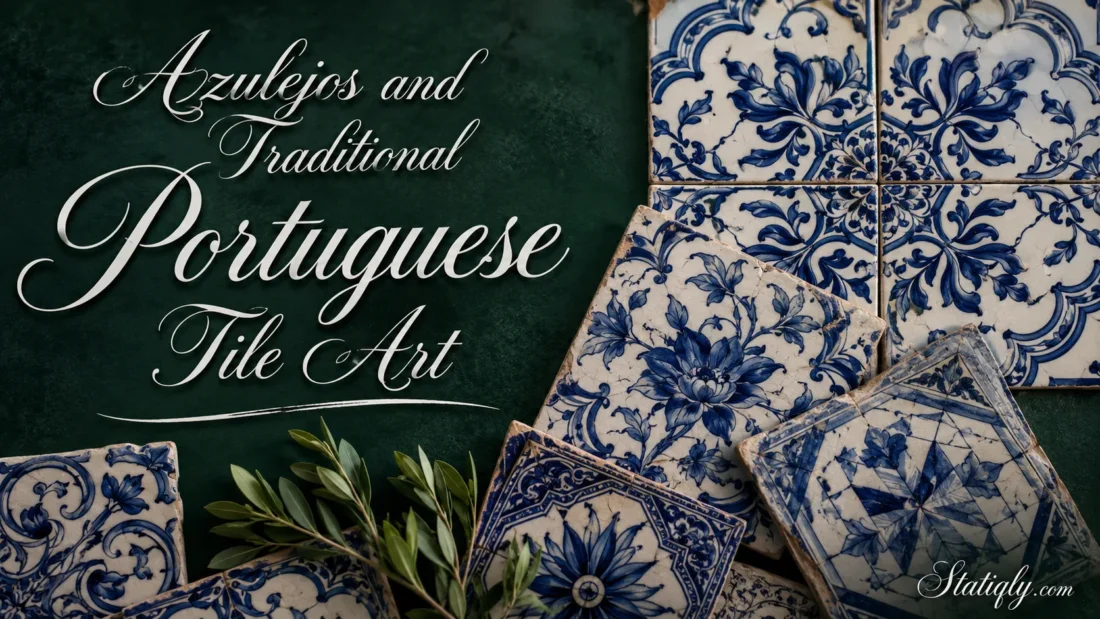
Azulejos are more than decorative ceramic tiles. In Portugal, they work like a public notebook made of clay, glaze, color, pattern, and memory. You see them on church walls, palace rooms, railway stations, stairways, fountains, shopfronts, and ordinary apartment façades. Some tell stories. Some repeat quiet geometric rhythms. Some simply make a white wall feel alive. That is the charm of traditional Portuguese tile art: it is artistic, practical, and deeply woven into daily space.
| Feature | What It Means | What to Notice |
|---|---|---|
| Material | Glazed ceramic tile, usually made from fired clay and covered with a painted or colored surface. | Look for shine, brushwork, small color shifts, and the way light moves across the glaze. |
| Common Places | Walls, façades, chapels, staircases, stations, gardens, kitchens, and public interiors. | Azulejos often connect the artwork to the building instead of hanging on it like a separate object. |
| Main Visual Styles | Geometric patterns, floral designs, repeated borders, blue-and-white scenes, and large narrative panels. | Step back first, then move closer. The full pattern often appears only from a distance. |
| Cultural Role | A long-lasting part of Portuguese visual culture, used in both grand and everyday settings. | The same art form can feel formal in one building and friendly in another. |
| Practical Value | Tiles protect surfaces, reflect light, and can handle busy interiors and exterior walls better than many painted finishes. | Beauty and function often sit side by side. That is one reason azulejos spread so widely. |
What Are Azulejos?
An azulejo is a glazed ceramic tile used as decoration and surface covering. The word is usually linked to the Arabic al-zulayj, often understood as “little stone” or “polished stone.” The name can confuse English speakers because it looks close to the Portuguese word azul, meaning blue. Yet azulejos are not only blue. They can be yellow, green, brown, white, cobalt, violet, or many colors at once.
Still, the blue-and-white style is the one many travelers remember first. It feels calm. It photographs well. It also turns a wall into something almost musical: repeated notes, clear spaces, and a rhythm that keeps going.
In Portugal, azulejos are not treated only as small craft objects. They often become part of the architecture itself. A tiled wall does not merely hold an image. It changes the room, the street, and the way a person moves through a place.
How Portuguese Tile Art Developed
Portuguese azulejo art grew through contact, trade, skilled workshops, changing taste, and local imagination. Early tile use in Portugal included geometric and patterned surfaces, with strong links to Iberian ceramic traditions. By the late 15th and early 16th centuries, tiles from workshops in places such as Seville and Toledo were used in major Portuguese buildings.
The early designs often used dense patterns. Empty space was rare. Walls could look like woven fabric, stone lattice, or painted carpet. This was not random decoration. The pattern helped a large room feel ordered, cool, and complete.
During the 16th century, local production in Lisbon began to grow. Foreign artisans, including Flemish makers, helped spread new ceramic knowledge. Over time, Portuguese workshops learned, adapted, and developed their own voice. The result was not a borrowed style left unchanged. It became something local, flexible, and easy to recognize.
The Early Patterned Phase
Early azulejos often used repeated shapes: stars, knots, chains, diamonds, and plant-like forms. These patterns were well suited to large walls because one tile could join the next like a sentence joining another sentence. Look long enough, and a flat surface begins to move.
- Geometric tiles created order and balance.
- Floral and vegetal motifs softened stone interiors.
- Border tiles framed doors, panels, benches, and staircases.
- Repeated modules allowed large areas to be covered with visual harmony.
The Rise of Painted Scenes
Later, azulejos became more pictorial. Instead of only repeating a motif, artists painted large panels across many tiles. These panels could show landscapes, gardens, ships, daily scenes, symbolic figures, or decorative stories. The wall became a ceramic page.
Blue-and-white panels became especially loved in the 17th and 18th centuries. The look was shaped by wider ceramic taste in Europe, including blue-and-white porcelain and Delft-style earthenware. Portuguese tile makers did not simply copy what they saw. They brought the style into local spaces and gave it scale.
That scale matters. A plate sits on a table. A tile panel surrounds you. It changes the air in the room.
Why Azulejos Became So Loved in Portugal
Azulejos suited Portuguese buildings in several ways. They added beauty, yes, but they also protected surfaces. A glazed tile can be cleaned more easily than bare plaster. It can reflect light into narrow interiors. On façades, tiles can give a building color and texture while helping the surface handle outdoor exposure.
There is also a human reason. Azulejos make architecture feel approachable. A tiled wall invites the eye to travel. One person notices the full pattern. Another notices a flower. Someone else sees the small imperfection where a hand once painted a curved line. Each viewer gets a different entry point.
That is why azulejos work in both grand halls and simple streets. They can be formal. They can be cheerful. Sometimes they are almost quiet.
Main Types of Traditional Portuguese Azulejo Designs
Portuguese tile art is wide, but several design families appear again and again. Knowing them helps a visitor read a tiled wall with more confidence.
Geometric Pattern Tiles
Geometric azulejos use repeated shapes to create a larger design. A single tile may look simple in the hand. Place hundreds together, and the surface becomes a field of movement. Stars, diamonds, interlacing bands, and cross shapes appear often.
These designs are easy to enjoy because they do not ask the viewer to “solve” a story. They ask you to look, pause, and follow the rhythm.
Floral and Plant Motifs
Flowers, leaves, vines, and fruit forms appear across many Portuguese tiles. Some feel delicate. Others are bold and almost architectural. Plant motifs soften hard walls and bring a garden-like quality indoors, especially in staircases, courtyards, and tiled rooms.
A flower on a tile is rarely just a flower. It also gives the wall a pulse.
Blue-and-White Narrative Panels
Blue-and-white panels are among the most familiar forms of Portuguese azulejo art. They often use cobalt blue painting on a white ground. Large panels may contain buildings, gardens, figures, animals, or scenic views. Some panels look like prints translated into ceramic.
Seen from far away, they read like one image. Seen close up, they become many small squares, each carrying part of the scene. That split between image and tile is part of the pleasure.
Patterned Façade Tiles
Many Portuguese towns and cities use azulejos on building façades. These exterior tiles can be patterned, floral, plain, or richly colored. They give streets a layered look, as if each building has its own fabric.
Façade tiles also show how azulejos entered everyday life. They were not limited to palaces or museums. They became part of streets, homes, shops, and apartment buildings. In some neighborhoods, a walk can feel like moving through an open-air tile album.
Border Tiles and Framing Pieces
Not every azulejo is the center of attention. Some of the most useful tiles are borders. They frame panels, outline benches, divide walls, and guide the eye through a room. A good border can make a large wall feel calm and organized.
Small pieces, big effect.
How Azulejos Are Made
Traditional tile making begins with clay. The clay is shaped into flat tiles, dried, and fired. A glaze is then applied to create a smooth surface that can hold color. Artists may paint directly onto the prepared tile surface before a later firing fixes the design.
The process sounds simple when reduced to steps. In practice, it asks for steady hands, knowledge of firing, and trust in the kiln. Colors can change after heat. Lines can soften. The final tile is always a meeting between planning and fire.
- Clay preparation: The base material is shaped and leveled.
- Drying: Moisture leaves the tile so it can survive firing.
- First firing: The clay hardens into ceramic.
- Glazing: A surface layer is added for shine, color, and protection.
- Painting or patterning: The design is applied by hand, stencil, mold, or other workshop methods.
- Final firing: Heat fixes the glaze and decoration.
Handmade tiles often show small differences in line, tone, and surface. Those differences are not flaws in the normal sense. They are traces of touch. They tell you a person made the object, not a machine pretending to be one.
Where to See Azulejos in Portugal
Azulejos appear across Portugal, but they are especially easy to notice in cities such as Lisbon and Porto. They also appear in towns, islands, religious buildings, railway stations, palaces, gardens, and private interiors. A visitor does not always need a museum ticket to meet them. Sometimes the best first lesson is a slow walk down a tiled street.
Lisbon
Lisbon is one of the easiest places to understand the range of azulejo art. The city has tiled façades, decorated interiors, historic panels, and the National Tile Museum, which presents Portuguese tile history in a chronological way. The museum is housed in the former Convent of Madre de Deus, so the building itself helps visitors understand how tiles work with architecture.
In Lisbon, azulejos are not hidden. They sit in plain view. On some streets, they turn ordinary corners into quiet galleries.
Porto
Porto is well known for striking blue-and-white tile panels in public interiors and on church façades. The city offers a clear lesson in scale: some azulejo works are small and domestic, while others cover broad walls and command attention from across a square.
For many visitors, Porto shows how ceramic art can turn movement through a city into a visual experience. You walk, then stop. The wall does that to you.
Sintra and Historic Palaces
Sintra’s historic interiors include early and later tile traditions, with rooms where patterns cover walls in close conversation with architecture. These spaces help explain why tiles became so useful in Portugal: they can decorate, divide, frame, cool, brighten, and give a room a clear identity.
Railway Stations and Public Buildings
Some Portuguese railway stations and civic interiors use azulejo panels to create a strong sense of place. These panels often show landscapes, work scenes, local life, or decorative views. Even when the subject is simple, the effect can be memorable because the image belongs to the building.
How to Read an Azulejo Wall
Azulejos reward slow looking. Start from a distance. Ask what the whole wall is doing. Is it telling a story? Creating a pattern? Framing a doorway? Brightening a narrow room? Then step closer and look at individual tiles.
- Look for repetition: Many designs depend on repeated shapes that only make sense when seen together.
- Notice the border: Borders often control the pace of the whole wall.
- Watch the corners: Pattern matching at corners can show the skill of the tile layer.
- Check the brushwork: Hand-painted lines may vary slightly from tile to tile.
- Think about the room: A tile panel often responds to doors, windows, benches, stairs, or light.
The best way to look is not to rush. A tiled wall is built from small units, so it asks for two kinds of attention: wide and close. Wide for the full design. Close for the human marks.
Azulejos as Public Art
One reason azulejos feel so special in Portugal is their public presence. Many art forms stay inside galleries. Azulejos often live outside, beside doorways, above shopfronts, around windows, and along streets used every day. They make public space feel cared for.
This does not mean every tile is old or rare. Portugal also has modern tile art, including works in metro stations, contemporary buildings, and new interiors. The tradition keeps moving because the tile is such a flexible object. A square piece of ceramic can carry a pattern, a face, a symbol, a map-like line, or pure color.
Small square. Long life.
Azulejos in Homes and Interior Design
Traditional Portuguese tiles are also used in homes. They can appear in kitchens, bathrooms, entry halls, garden walls, stair risers, and fireplaces. A single panel can act like artwork. A repeated pattern can make a plain surface feel warmer and more personal.
For home use, the safest and most respectful choice is to buy new handmade tiles, contemporary reproductions, or clearly documented pieces from trusted sellers. Historic tiles belong in protected places and original buildings. New tiles keep the craft alive without removing older work from where it belongs.
Simple Design Ideas Inspired by Portuguese Tiles
- Use one patterned tile as a small accent in a plain room.
- Choose a border tile to frame a mirror, shelf, or doorway.
- Mix blue-and-white tiles with natural wood for a softer look.
- Place patterned tiles on stair risers for movement without covering a full wall.
- Use repeated geometric tiles when the room needs order and rhythm.
Good tile design does not need to shout. Often, one carefully placed surface is enough.
Small Details Worth Noticing
Azulejo art becomes easier to appreciate when you know what to look for. The following details can turn a casual glance into a richer viewing experience.
| Detail | Why It Matters |
|---|---|
| Tile Joints | The thin lines between tiles can become part of the design, especially in large panels. |
| Color Depth | Glaze can make one color feel lighter, darker, or softer depending on the firing and surface. |
| Repeated Corners | Corner motifs help patterns connect smoothly across a wall. |
| Panel Borders | Borders often frame the central image like a ceramic picture frame. |
| Architectural Fit | The best tile work feels planned for the wall, not simply attached to it. |
| Small Variations | Handwork can create tiny differences that add warmth and character. |
Why Azulejos Still Feel Fresh
Azulejos last because they solve more than one need. They decorate, protect, brighten, guide, and tell stories. They can be humble or grand. They can cover a palace room or a small kitchen wall. They can use old patterns and still feel right in a new space.
There is also a quiet lesson in them. A single tile does not do much alone. Put many together, and they can change a street. That is why Portuguese tile art stays in the mind: it turns patience into surface, and surface into place.
Common Questions About Azulejos
Are Azulejos Always Blue and White?
No. Blue-and-white azulejos are very well known, but Portuguese tile art also includes many other colors. Earlier and later tiles may use yellow, green, brown, violet, black, white, and mixed color palettes.
Are Azulejos Only Found in Portugal?
No. Related glazed tile traditions appear in other places, especially across Iberian and Mediterranean ceramic history. Portugal, though, developed a very strong and visible azulejo culture, with tiles used widely in architecture, public space, and daily life.
What Makes Portuguese Azulejos Different?
Their strong link with architecture is one of the main differences. In Portugal, azulejos often cover broad surfaces, frame rooms, decorate façades, and create large visual programs. They are not only small ornaments. They shape places.
Can Modern Artists Still Use Azulejo Techniques?
Yes. Azulejo art is not frozen in the past. Modern artists and designers still use ceramic tiles for murals, interiors, public works, and contemporary patterns. The material remains useful because it is durable, clear, and visually flexible.
How Should Visitors Appreciate Azulejos Respectfully?
Look closely, take time, and treat tiled buildings as cultural spaces. When buying tiles, choose new work, contemporary reproductions, or pieces with clear and responsible documentation. The best souvenir is one that supports living craft without harming historic places.