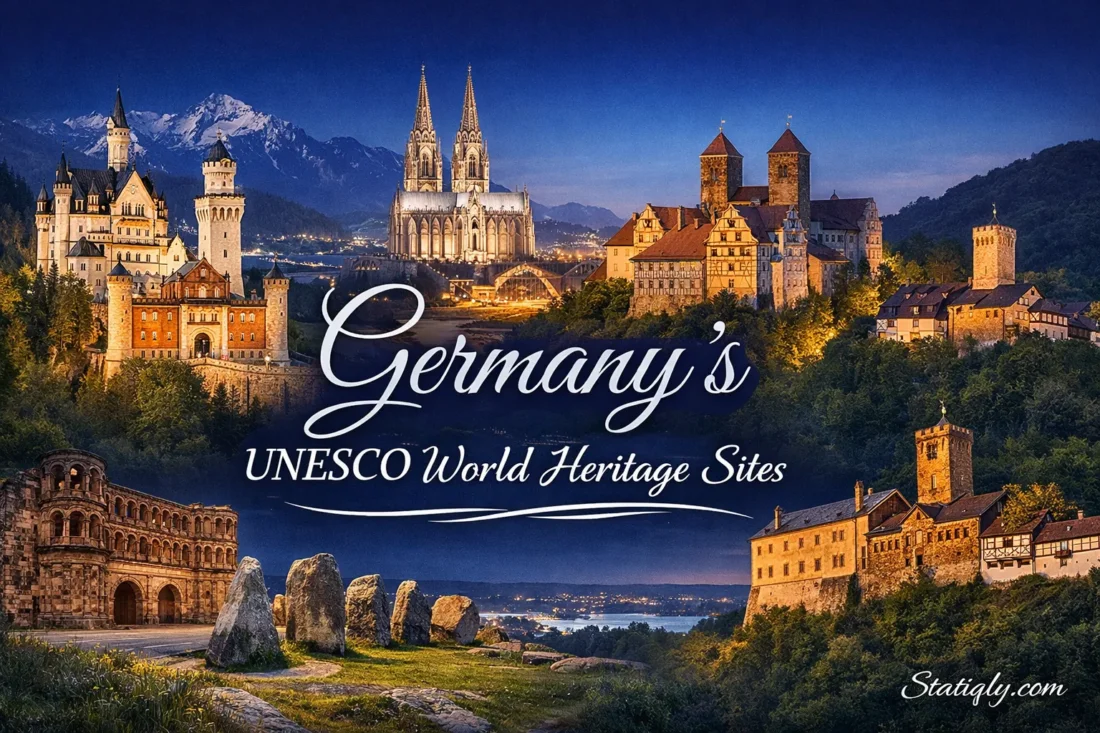
Germany’s UNESCO World Heritage Sites are like a carefully packed suitcase: cathedrals, gardens, old towns, bold modern design, and wide-open nature—all in one place. Want a trip that feels rich without feeling rushed? These sites help you choose well, move smart, and notice the details that most people walk past.
What You’ll Get From This Guide
- Clear context for UNESCO World Heritage and what the label really means for visitors
- Practical ways to pick sites by mood, not just by map pins
- A complete, copy-friendly list of Germany’s World Heritage Sites (with inscription years)
- Simple regional pairings so your days feel smooth, not scattered
Jump To
Germany’s UNESCO World Heritage Sites, In Numbers
| Category | How Many | What It Usually Feels Like | Easy Examples |
|---|---|---|---|
| Total | 55 | A broad mix: cities, architecture, landscapes, industry, archaeology | Cathedrals, old towns, designed parks, coastlines |
| Cultural | 52 | Streets with long memories, buildings built to impress, ideas made visible | Cologne Cathedral, Bauhaus Sites, Speicherstadt |
| Natural | 3 | Big skies, quiet trails, and places where nature leads the schedule | Wadden Sea, Messel Pit, Ancient Beech Forests |
A Small “What’s New” Note
- Schwerin Residence Ensemble joined the list in 2024.
- Moravian Church Settlements includes Herrnhut in Germany as part of its 2024 extension.
- The Palaces of King Ludwig II of Bavaria were inscribed in 2025 (Neuschwanstein, Linderhof, Schachen, Herrenchiemsee).
- Berlin Modernism Housing Estates was extended in 2026 to include Waldsiedlung Zehlendorf as the seventh component of the serial property. This was an extension of an existing World Heritage property, so Germany’s total remains 55.
What Makes A Place UNESCO World Heritage?
Think of UNESCO World Heritage as a global “must-keep” list. A site is added because it carries Outstanding Universal Value—meaning it matters beyond one city, beyond one country, beyond one generation. For you as a traveler, that label often signals three things: the place is distinct, it is well cared for, and it rewards slow looking.
Germany’s set is especially varied. One day you can be in a medieval old town where every corner feels like a postcard. The next day you’re standing in a modernist housing estate, where design choices quietly shaped daily life. That contrast is the point—and it keeps trips feeling fresh.
How To Choose Sites Without Feeling Overwhelmed
Fifty-five sites can feel like a buffet that’s too big. So pick your trip like you pick music: by vibe. What do you want to feel when you step outside each morning?
Storybook Streets
Old towns and city ensembles where the best plan is simply to wander.
- Hanseatic City of Lübeck
- Town of Bamberg
- Old town of Regensburg with Stadtamhof
- Historic Centres of Stralsund and Wismar
- Upper Middle Rhine Valley
Architecture With A Wow Factor
Places that make you tilt your head and ask, “How did they even build this?”
- Cologne Cathedral
- Würzburg Residence with the Court Gardens and Residence Square
- Speicherstadt and Kontorhaus District with Chilehaus
- Margravial Opera House Bayreuth
- Mathildenhöhe Darmstadt
Nature That Sets The Pace
Breathing room. Trails. Shorelines. Quiet wonder.
- Wadden Sea
- Messel Pit Fossil Site
- Ancient and Primeval Beech Forests of the Carpathians and Other Regions of Europe
A Simple Rule That Works Surprisingly Well
Mix one “big” site with one “slow” site each day. A cathedral or palace in the morning, a garden landscape or old town stroll later. Your brain stays curious. Your feet stay happy.
Plan Smart, Travel Easy
Timing And Transport
- Base yourself in one city for 3–4 nights, then take day trips. It cuts packing time to near zero.
- Start early at headline sites. Midday is perfect for parks, old towns, or museum districts.
- Use trains for city-to-city travel and regional connections. It’s often the calmest way to move.
- Build buffers: add 30–45 minutes for slow looking, coffee stops, and “one more photo” moments.
Tickets, Hours, And Small Etiquette Wins
- Check opening hours close to your travel dates. Seasonal schedules are common.
- Reserve timed-entry when it’s offered. It turns waiting into walking.
- Keep voices soft in cathedrals, churches, and memorial buildings. The atmosphere is part of the experience.
- Bring a light layer for large stone interiors. Even warm days can feel cool inside.
If You’re Traveling With Kids
- Pick “movement” sites (parks, garden landscapes, waterfronts) to balance indoor time.
- Try industrial heritage like Zollverein or Völklingen—big spaces, bold shapes, lots to point at.
- Choose one cathedral, not five. Make it special with a tower climb or a nearby old town walk.
Full List Of Germany’s UNESCO World Heritage Sites
Below is the complete list, arranged by UNESCO category. The inscription years are shown in parentheses. Sites with multiple years were inscribed and later extended.
Cultural World Heritage Sites (52)
- Aachen Cathedral (1978)
- Abbey and Altenmünster of Lorsch (1991)
- Archaeological Border complex of Hedeby and the Danevirke (2018)
- Bauhaus and its Sites in Weimar, Dessau and Bernau (1996, 2017)
- Bergpark Wilhelmshöhe (2013)
- Berlin Modernism Housing Estates (2008; extended 2026)
- Carolingian Westwork and Civitas Corvey (2014)
- Castles of Augustusburg and Falkenlust at Brühl (1984)
- Caves and Ice Age Art in the Swabian Jura (2017)
- Classical Weimar (1998)
- Collegiate Church, Castle and Old Town of Quedlinburg (1994)
- Cologne Cathedral (1996)
- Erzgebirge/Krušnohoří Mining Region (2019)
- Fagus Factory in Alfeld (2011)
- Frontiers of the Roman Empire (1987, 2005, 2008)
- Frontiers of the Roman Empire – The Danube Limes (Western Segment) (2021)
- Frontiers of the Roman Empire – The Lower German Limes (2021)
- Garden Kingdom of Dessau-Wörlitz (2000)
- Hanseatic City of Lübeck (1987)
- Historic Centres of Stralsund and Wismar (2002)
- Jewish-Medieval Heritage of Erfurt (2023)
- Luther Memorials in Eisleben and Wittenberg (1996)
- Margravial Opera House Bayreuth (2012)
- Mathildenhöhe Darmstadt (2021)
- Maulbronn Monastery Complex (1993)
- Mines of Rammelsberg, Historic Town of Goslar and Upper Harz Water Management System (1992, 2010)
- Monastic Island of Reichenau (2000)
- Moravian Church Settlements (2015, 2024)
- Museumsinsel (Museum Island), Berlin (1999)
- Muskauer Park / Park Mużakowski (2004)
- Naumburg Cathedral (2018)
- Old town of Regensburg with Stadtamhof (2006)
- Palaces and Parks of Potsdam and Berlin (1990, 1992, 1999)
- Pilgrimage Church of Wies (1983)
- Prehistoric Pile Dwellings around the Alps (2011)
- Roman Monuments, Cathedral of St Peter and Church of Our Lady in Trier (1986)
- Schwerin Residence Ensemble (2024)
- ShUM Sites of Speyer, Worms and Mainz (2021)
- Speicherstadt and Kontorhaus District with Chilehaus (2015)
- Speyer Cathedral (1981)
- St Mary’s Cathedral and St Michael’s Church at Hildesheim (1985)
- The Architectural Work of Le Corbusier, an Outstanding Contribution to the Modern Movement (2016)
- The Great Spa Towns of Europe (2021)
- The Palaces of King Ludwig II of Bavaria: Neuschwanstein, Linderhof, Schachen and Herrenchiemsee (2025)
- Town Hall and Roland on the Marketplace of Bremen (2004)
- Town of Bamberg (1993)
- Upper Middle Rhine Valley (2002)
- Völklingen Ironworks (1994)
- Wartburg Castle (1999)
- Water Management System of Augsburg (2019)
- Würzburg Residence with the Court Gardens and Residence Square (1981)
- Zollverein Coal Mine Industrial Complex in Essen (2001)
Natural World Heritage Sites (3)
- Ancient and Primeval Beech Forests of the Carpathians and Other Regions of Europe (2007, 2011, 2017, 2021)
- Messel Pit Fossil Site (1995)
- Wadden Sea (2009, 2014)
Simple Regional Pairings That Make Planning Easier
If you like trips that “click,” try pairing sites that sit naturally together. These combinations keep travel time modest and variety high.
| Region Feel | Easy Pairing | Why It Works |
|---|---|---|
| North | Lübeck + Speicherstadt (Hamburg) + Wadden Sea | Brick architecture, harbor culture, and open coastal horizons in one arc |
| East | Museum Island (Berlin) + Potsdam & Berlin Palaces + Dessau-Wörlitz | Museums and landscapes with elegant day-trip rhythm |
| Central | Wartburg Castle + Classical Weimar + Bauhaus Sites | A tight triangle of ideas, design, and memorable settings |
| West | Cologne Cathedral + Lower German Limes + Upper Middle Rhine Valley | Iconic skyline moments, archaeology, and river scenery that feels cinematic |
| South | Würzburg Residence + Wies Church + King Ludwig II Palaces | Ornate interiors, mountain air, and the kind of architecture people remember for years |
Questions People Usually Ask Before They Book
How Many UNESCO World Heritage Sites Are In Germany?
Germany currently has 55 properties on the UNESCO World Heritage List: 52 cultural and 3 natural.
Do I Need A Car To Visit Them?
Not usually. Many headline sites sit in or near major cities and work well with trains and local transit. A car can help for countryside stretches, but it’s rarely essential for a strong itinerary.
Which Sites Feel Most Different From Each Other?
Try a “contrast day”: a classic cathedral or palace, then a modernist or industrial site, then a landscape walk. It’s like switching camera lenses—suddenly, the whole country looks new again.
What If I Only Have A Weekend?
Pick one base city, then choose two day themes: architecture on day one and strolling on day two. You’ll leave feeling satisfied instead of scattered.