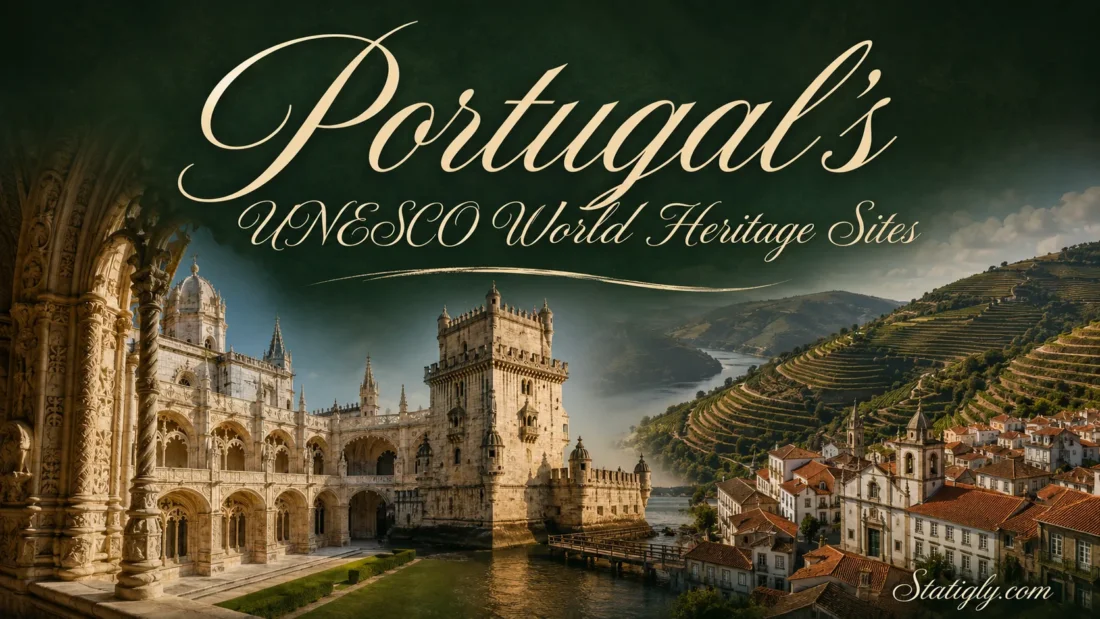
Portugal’s UNESCO World Heritage Sites show the country through old stone streets, coastal monasteries, terraced vineyards, island forests, university courtyards, and quiet sacred places. They are not just famous places to visit. They help explain how Portugal grew around the sea, faith, trade, craft, learning, farming, and landscape. Some sites sit in busy cities. Others feel tucked away, almost hidden, until you stand there and notice the detail.
Portugal currently has 17 UNESCO World Heritage Sites. Most are cultural sites, while one is natural: the Laurisilva of Madeira. For travelers, students, and country-curious readers, the list gives a useful path through Portugal without turning the country into a checklist. Lisbon and Porto matter, yes. But so do Évora, Tomar, Guimarães, Pico, Elvas, Coimbra, Braga, Madeira, and the Douro Valley.
Portugal’s UNESCO World Heritage Sites in One Place
The table below keeps the full list simple. It shows the official site name, the year of inscription, the main region, and the kind of heritage each place represents.
| UNESCO World Heritage Site | Year | Region | Main Heritage Type |
|---|---|---|---|
| Central Zone of the Town of Angra do Heroismo in the Azores | 1983 | Azores | Island town and maritime heritage |
| Monastery of the Hieronymites and Tower of Belém in Lisbon | 1983 | Lisbon | Manueline architecture and seafaring history |
| Monastery of Batalha | 1983 | Central Portugal | Gothic and Manueline monastery architecture |
| Convent of Christ in Tomar | 1983 | Central Portugal | Religious architecture and historic complex |
| Historic Centre of Évora | 1986 | Alentejo | Historic city center |
| Monastery of Alcobaça | 1989 | Central Portugal | Cistercian monastery architecture |
| Cultural Landscape of Sintra | 1995 | Lisbon Region | Palaces, gardens, hills, and romantic landscape |
| Historic Centre of Oporto, Luiz I Bridge and Monastery of Serra do Pilar | 1996 | Northern Portugal | Historic riverside cityscape |
| Prehistoric Rock Art Sites in the Côa Valley and Siega Verde | 1998, 2010 | Northern Portugal and Spain | Prehistoric open-air rock art |
| Laurisilva of Madeira | 1999 | Madeira | Natural laurel forest |
| Alto Douro Wine Region | 2001 | Northern Portugal | Terraced vineyard landscape |
| Historic Centre of Guimarães and Couros Zone | 2001, 2023 | Northern Portugal | Historic urban fabric and craft district |
| Landscape of the Pico Island Vineyard Culture | 2004 | Azores | Island vineyard landscape |
| Garrison Border Town of Elvas and its Fortifications | 2012 | Alentejo | Fortified town and military engineering |
| University of Coimbra – Alta and Sofia | 2013 | Central Portugal | Academic and urban heritage |
| Royal Building of Mafra – Palace, Basilica, Convent, Cerco Garden and Hunting Park | 2019 | Lisbon Region | Royal, religious, garden, and landscape complex |
| Sanctuary of Bom Jesus do Monte in Braga | 2019 | Northern Portugal | Sacred landscape and monumental stairway |
What Makes Portugal’s UNESCO List So Varied?
Portugal’s list feels wide because the country itself is wide in character. A small country on the map can hold very different worlds. Atlantic islands. Granite towns. Whitewashed Alentejo streets. River valleys shaped by hand. Monasteries built with patience. Forests that keep older ecological stories alive.
The sites fall into a few natural groups. This makes the list easier to understand, especially for readers planning a route or trying to see what each place adds to Portugal’s identity.
- Historic Cities: Porto, Évora, Guimarães, Angra do Heroismo, and Coimbra show how Portuguese towns developed through streets, squares, public buildings, schools, churches, and everyday life.
- Monasteries and Sacred Sites: Batalha, Alcobaça, Tomar, Belém, Braga, and Mafra show religious art, architecture, ceremony, and craftsmanship.
- Cultural Landscapes: Sintra, Alto Douro, and Pico show how people shaped land without erasing its natural character.
- Island and Natural Heritage: Madeira’s laurel forest and the Azorean sites show the Atlantic side of Portugal.
- Archaeology and Early Art: The Côa Valley and Siega Verde preserve one of Europe’s striking open-air rock art records.
Lisbon and Nearby UNESCO Sites
Lisbon is often the first stop for visitors, and it gives easy access to several UNESCO-listed places. These sites are not all the same type. One speaks through riverfront stonework. Another through misty hills and palace gardens. Another through royal scale and formal design.
Monastery of the Hieronymites and Tower of Belém in Lisbon
The Monastery of the Hieronymites and the Tower of Belém sit near the Tagus River, where Lisbon’s maritime story feels close. The stonework has a refined, carved quality, often linked with Portugal’s Manueline style. Ropes, spheres, plants, arches, and delicate details appear in the architecture. The buildings feel ceremonial, but also tied to ships, water, and movement.
This site works well for first-time visitors because it explains a major part of Portugal’s identity without needing a long lecture. Stand near the river, look at the tower, then look back at the monastery. The setting does half the work.
Cultural Landscape of Sintra
Sintra feels different from central Lisbon almost at once. The air changes. The hills rise. Palaces, gardens, walls, villas, and wooded paths sit together in a way that feels planned, yet still alive. It is called a cultural landscape because the value does not rest on one building alone. The whole scene matters.
Sintra is easy to enjoy, but it rewards slow attention. A palace room, a garden path, a viewpoint, a tile panel, a patch of shade; each part adds to the mood. It is one of Portugal’s best examples of landscape and architecture speaking in the same voice.
Royal Building of Mafra
The Royal Building of Mafra includes a palace, basilica, convent, garden, and hunting park. Its scale is the first thing many visitors notice. Then the detail follows. Mafra is not only a grand building; it is a full planned complex with religious, royal, and landscape elements connected to one another.
For readers who enjoy architecture, Mafra gives a useful contrast with Belém and Sintra. Belém looks toward the river. Sintra blends with hills and gardens. Mafra feels more formal, balanced, and monumental.
Northern Portugal’s UNESCO Sites
Northern Portugal carries many of the country’s most visited UNESCO places. Porto, Guimarães, the Douro Valley, Braga, and the Côa Valley each show a different side of the region. Here, stone towns meet river landscapes, sacred stairways, vineyards, and early art.
Historic Centre of Oporto, Luiz I Bridge and Monastery of Serra do Pilar
Porto’s UNESCO site is not a single monument. It is a layered riverside cityscape. The Historic Centre of Oporto, the Luiz I Bridge, and the Monastery of Serra do Pilar work together across the Douro River. The view from one side explains the other.
Narrow streets drop toward the river. Buildings stand close, their facades catching light in uneven ways. The bridge gives the city its strong visual line. Porto is best read on foot, slowly, with pauses. Too fast, and the city becomes just a view. Slowly, it becomes a place.
Historic Centre of Guimarães and Couros Zone
Guimarães is one of Portugal’s most meaningful historic cities. Its UNESCO listing includes the historic center and the Couros Zone, an area linked with traditional leather-related craft activity. The value here sits in the street pattern, building forms, public spaces, and the relationship between the old urban core and a working craft district.
Guimarães has a human scale. The streets invite walking rather than rushing. Its appeal is not only in famous landmarks, but in the way the town holds together as a lived historic place.
Alto Douro Wine Region
The Alto Douro Wine Region is one of Portugal’s great cultural landscapes. Terraced vineyards climb the slopes above the Douro River, showing long human work with difficult land. The view is beautiful, of course. But beauty is not the whole story. The terraces, paths, walls, farms, and river setting show how landscape can become heritage through repeated care.
This is a place where geography is easy to see. The river bends. The slopes rise. The land asks for effort. People answered with terraces.
Sanctuary of Bom Jesus do Monte in Braga
The Sanctuary of Bom Jesus do Monte in Braga is known for its monumental stairway, sacred setting, chapels, fountains, and designed ascent. The experience is physical as well as visual. Visitors move upward, step by step, through a planned route that links architecture, landscape, and devotion.
Even for readers who approach it mainly as architecture, Bom Jesus do Monte has a clear rhythm. The stairs guide the eye and the body at the same time. That is the point. The route matters as much as the destination.
Prehistoric Rock Art Sites in the Côa Valley and Siega Verde
The Prehistoric Rock Art Sites in the Côa Valley and Siega Verde are shared between Portugal and Spain. They preserve open-air rock engravings, many linked with early human artistic expression. Unlike art kept inside a cave or museum, this site sits in the landscape. The rocks, valley, light, and open setting all shape the experience.
This site adds great depth to Portugal’s UNESCO list. Monasteries and cities show built heritage. The Côa Valley reaches much further back, to a time when mark-making, animals, stone, and landscape were already tied together in human expression.
Central Portugal’s Monasteries and University Heritage
Central Portugal holds several UNESCO sites that are especially strong for architecture lovers. Batalha, Alcobaça, Tomar, and Coimbra are close enough to form a focused heritage route. Each place has its own tone. Some feel quiet. Some feel grand. Some carry a mix of both.
Monastery of Batalha
The Monastery of Batalha is one of Portugal’s best-known Gothic monuments. Its stonework is sharp, vertical, and finely handled. The monastery also includes Manueline details, which give parts of the building a more decorative and carved character.
Batalha is a place to look up. Windows, arches, ribs, portals, and unfinished spaces pull the eye from one feature to another. The building teaches through detail, not noise.
Monastery of Alcobaça
The Monastery of Alcobaça has a different personality. It is often admired for its Cistercian clarity: large spaces, clean lines, careful proportions, and a sense of restraint. It does not need heavy decoration to feel powerful. In fact, its plainness is part of its strength.
Alcobaça is useful for understanding how architecture can create calm. The space feels measured. Quiet, but not empty.
Convent of Christ in Tomar
The Convent of Christ in Tomar is one of Portugal’s most layered heritage complexes. It includes architecture from different periods, with Romanesque, Gothic, Manueline, Renaissance, and other later elements. The famous round church is one of its most memorable spaces, while the wider complex shows how religious, artistic, and architectural ideas changed over time.
Tomar rewards curiosity. A doorway here, a window there, a cloister after that. The site feels like a long conversation in stone.
University of Coimbra – Alta and Sofia
The University of Coimbra – Alta and Sofia connects education, city life, ceremony, and architecture. Coimbra is not only a place where old buildings survived. It is a city where learning shaped the urban character over many generations.
The Alta area and Sofia area help show how the university influenced streets, buildings, movement, and identity. For readers interested in academic heritage, Coimbra is one of Portugal’s most rewarding UNESCO sites.
Alentejo UNESCO Sites
Alentejo brings a different mood to Portugal’s UNESCO list. The light is wider. The streets often feel quieter. Évora and Elvas show urban heritage in two very different ways: one through a historic inland city, the other through a fortified border town with a strong planned structure.
Historic Centre of Évora
The Historic Centre of Évora is one of Portugal’s most complete historic urban centers. Its white buildings, narrow streets, public squares, religious buildings, and older remains create a compact city with many layers. It is easy to walk, easy to read, and easy to enjoy without a strict route.
Évora is best experienced slowly. A short walk may pass a quiet street, a major monument, a shaded square, and a small local detail in just a few minutes. That is the charm: the heritage does not sit in one spot. It spreads through the city.
Garrison Border Town of Elvas and Its Fortifications
The Garrison Border Town of Elvas and its Fortifications shows a planned defensive landscape with walls, forts, and military engineering adapted to the border setting. The site includes the town and surrounding structures, so the value comes from the whole system rather than one isolated building.
For general readers, Elvas is useful because it shows another form of heritage: planning, geometry, movement, and protection built into the landscape. It is not only about walls. It is about how a town was shaped by its position.
Portugal’s Atlantic Island UNESCO Sites
Portugal’s island heritage adds range to the list. The Azores and Madeira are not side notes. They show how Atlantic geography shaped settlement, farming, architecture, ecology, and travel. The islands bring ocean air into the UNESCO story.
Central Zone of the Town of Angra do Heroismo in the Azores
Angra do Heroismo is a historic town in the Azores with a strong maritime character. Its central zone reflects the role of Atlantic navigation, island settlement, civic life, and urban planning. The town sits between land and sea in a way that feels natural for an island crossroads.
Angra is a good reminder that Portugal’s heritage is not only continental. The Atlantic islands helped shape movement, exchange, and identity across long distances.
Landscape of the Pico Island Vineyard Culture
The Landscape of the Pico Island Vineyard Culture is one of Portugal’s most distinctive vineyard sites. On Pico, vines grow in small plots protected by dark stone walls. These walls help shield the vines from wind and salt air while creating a striking pattern across the land.
This is heritage shaped by adaptation. The land was not easy. People worked with stone, weather, and sea influence to create a vineyard landscape unlike the Douro or mainland Portugal.
Laurisilva of Madeira
The Laurisilva of Madeira is Portugal’s only natural UNESCO World Heritage Site. It protects a laurel forest ecosystem with deep ecological value. For visitors, it can feel like stepping into a green, humid, older layer of the island, where trees, mosses, slopes, and mist create a very different kind of heritage experience.
This site balances the rest of the list. After cities, monasteries, palaces, vineyards, and planned landscapes, Madeira’s forest reminds readers that heritage can also be living, breathing, and rooted in ecology.
Best Ways To Understand The List
Portugal’s UNESCO sites make more sense when grouped by travel style or interest. A visitor who loves architecture may choose a different route from someone who wants landscapes. A reader studying culture may follow cities first. No single order fits everyone.
| Interest | Best Sites To Start With | Why They Fit |
|---|---|---|
| Historic Cities | Porto, Évora, Guimarães, Coimbra, Angra do Heroismo | They show streets, squares, public buildings, and long urban continuity. |
| Architecture | Batalha, Alcobaça, Tomar, Belém, Mafra | They offer strong examples of monastery, royal, sacred, and decorative stone architecture. |
| Landscapes | Sintra, Alto Douro, Pico, Madeira | They show how nature, farming, gardens, and terrain shape heritage. |
| Island Heritage | Angra do Heroismo, Pico, Laurisilva of Madeira | They explain Portugal’s Atlantic character beyond the mainland. |
| Older Human Expression | Côa Valley and Siega Verde | The site reaches back to prehistoric art in an open landscape setting. |
How Many Days Do You Need?
Seeing every UNESCO site in Portugal takes time because the list spreads across the mainland, Madeira, and the Azores. A short trip can still cover a strong sample. The best plan is to choose one region and go deeper instead of rushing across the map.
- Two To Three Days: Focus on Lisbon, Belém, Sintra, and possibly Mafra.
- Four To Six Days: Add Porto, Guimarães, Braga, and the Douro Valley.
- One Week Or More: Include Central Portugal sites such as Batalha, Alcobaça, Tomar, and Coimbra.
- Longer Trip: Add Alentejo, Madeira, or the Azores for a fuller view of Portugal’s heritage.
Travelers who enjoy slow routes should avoid treating the sites like stamps in a passport. Portugal rewards patience. Sit in a square. Walk the side street. Look at the stone. Then move on.
Mainland Routes That Work Well
A practical mainland route can begin in Lisbon, continue to Sintra and Mafra, then move north through Central Portugal toward Coimbra, Porto, Guimarães, Braga, and the Douro. Alentejo can work as a separate route with Évora and Elvas.
Lisbon, Sintra, and Mafra Route
- Start With Belém: Visit the monastery and tower area near the river.
- Continue To Sintra: Allow time for hills, gardens, viewpoints, and palace areas.
- Add Mafra: Use Mafra for a broader view of royal and religious architecture near Lisbon.
Central Portugal Route
- Batalha: Best for Gothic and Manueline stonework.
- Alcobaça: Best for calm scale and Cistercian clarity.
- Tomar: Best for layered architecture and cloister spaces.
- Coimbra: Best for university heritage and historic urban character.
Northern Portugal Route
- Porto: Start with the riverside historic center and viewpoints.
- Guimarães: Add a compact historic city with strong identity.
- Braga: Visit Bom Jesus do Monte for sacred landscape and stairway design.
- Alto Douro: Slow down in the vineyard landscape and river valley.
Which Sites Are Best For First-Time Visitors?
First-time visitors often want places that are easy to reach, visually clear, and rich in context. These sites are strong starting points:
- Belém in Lisbon: Easy to reach and closely tied to Portugal’s maritime identity.
- Sintra: A memorable mix of hills, architecture, gardens, and atmosphere.
- Porto: A living historic city with river views and layered streets.
- Évora: A walkable inland city with a clear historic center.
- Coimbra: A strong choice for readers interested in education, ceremony, and city form.
After that, the choice becomes personal. Some people will prefer the calm of Alcobaça. Some will love the drama of the Douro Valley. Others may remember Madeira’s forest more than any building. That is the beauty of Portugal’s list: it does not speak in one accent.
What The Sites Reveal About Portugal
Taken together, Portugal’s UNESCO World Heritage Sites show a country shaped by Atlantic movement, religious architecture, urban continuity, craft traditions, vineyard landscapes, and island ecology. The list is not random. It has a pattern.
Lisbon and Porto show riverside cities with deep public life. Sintra, Douro, and Pico show land shaped with imagination and labor. Batalha, Alcobaça, Tomar, Belém, Braga, and Mafra show how architecture can carry belief, skill, and ceremony. Coimbra shows learning as part of the city itself. Madeira shows natural heritage still alive in green slopes and forest paths.
Seen this way, Portugal’s UNESCO list becomes more than a travel list. It becomes a readable map of the country’s character.
Helpful Notes Before Visiting
- Check Opening Times: Monuments, museums, gardens, and managed areas may follow seasonal schedules.
- Book Popular Sites Early: Sintra and Belém can be busy, especially during peak travel months.
- Respect Local Rules: Some sites include active religious spaces, protected landscapes, or fragile heritage areas.
- Wear Comfortable Shoes: Many historic centers have stone streets, slopes, stairs, and uneven surfaces.
- Allow Quiet Time: The best details often appear when you stop rushing.
Common Questions About Portugal’s UNESCO World Heritage Sites
How Many UNESCO World Heritage Sites Are in Portugal?
Portugal has 17 UNESCO World Heritage Sites. The list includes 16 cultural sites and 1 natural site.
What Is Portugal’s Only Natural UNESCO World Heritage Site?
Portugal’s only natural UNESCO World Heritage Site is the Laurisilva of Madeira. It protects an important laurel forest ecosystem on Madeira Island.
Which UNESCO Sites Are Near Lisbon?
The main UNESCO sites near Lisbon are the Monastery of the Hieronymites and Tower of Belém, the Cultural Landscape of Sintra, and the Royal Building of Mafra.
Which Portuguese UNESCO Sites Are Best For Architecture?
Strong choices for architecture include Batalha, Alcobaça, Tomar, Belém, Mafra, and Bom Jesus do Monte. Each site shows a different use of space, stone, design, and setting.
Are Any Portugal UNESCO Sites on The Islands?
Yes. Portugal has UNESCO sites in the Azores and Madeira. These include Angra do Heroismo, the Landscape of the Pico Island Vineyard Culture, and the Laurisilva of Madeira.
Can You Visit Several Portugal UNESCO Sites in One Trip?
Yes. Many mainland sites can be combined by region. Lisbon, Sintra, and Mafra work well together. Porto, Guimarães, Braga, and the Douro Valley also make a strong northern route. The island sites need separate planning because they are in the Azores and Madeira.