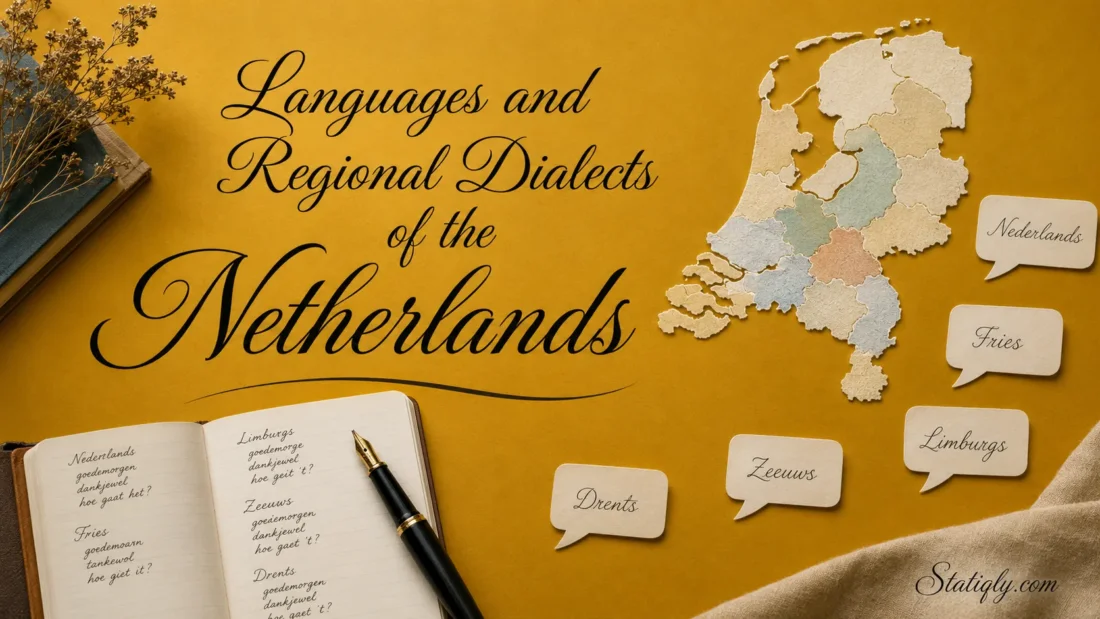
Language in the Netherlands changes over remarkably short distances. Standard Dutch connects the country, yet a train journey of less than an hour can bring new accents, local words, and different speech rhythms. Frisian has official status in Fryslân, while Limburgish and Low Saxon are recognized regional languages. Dutch Sign Language, Papiamentu, English, and several non-territorial languages also form part of the country’s linguistic life.
Dutch is the main language of education, public services, national media, and everyday communication. It is understood throughout the Netherlands. Regional speech remains easy to hear, especially in family conversations, local broadcasting, music, theatre, and community events.
Recognized Languages and Their Main Areas
| Language | Status In The Netherlands | Main Area and Use |
|---|---|---|
| Dutch | Official language | Used nationwide in government, education, media, business, and daily life |
| Frisian (Frysk) | Official alongside Dutch in Fryslân | Used in homes, schools, provincial life, local media, and contact with public authorities in Fryslân |
| Low Saxon (Nedersaksisch) | Recognized regional language | Spoken mainly in Groningen, Drenthe, Overijssel, Gelderland, and nearby areas |
| Limburgish (Limburgs) | Recognized regional language | Spoken across Limburg through many town and district varieties |
| Dutch Sign Language (Nederlandse Gebarentaal) | Recognized by national law | Used by Dutch signers in personal, educational, cultural, and public settings |
| Papiamentu | Officially recognized in the Caribbean Netherlands | The main local language on Bonaire; permitted in education, public services, and courts |
| English | Officially recognized in the Caribbean Netherlands | Widely used on Sint Eustatius and Saba, including in education and public communication |
| Yiddish and Romanes | Recognized non-territorial languages | Used by communities whose speakers are not concentrated in one Dutch region |
Official language, regional language, and dialect do not mean the same thing. Their labels describe legal status, social use, linguistic structure, or a mixture of these. A regional language may contain several local varieties, just as Dutch contains many dialects and accents.
Standard Dutch In Daily Life
Standard Dutch is called Standaardnederlands or, less formally, Algemeen Nederlands. It supplies the shared spelling and grammar used in schools, official documents, national news, books, and most professional communication.
Shared does not mean identical. A speaker from Amsterdam may pronounce the same standard sentence differently from someone in Maastricht or Groningen. Both may still be speaking Standard Dutch. Regional pronunciation can remain clear even when grammar and vocabulary follow the national norm.
Dutch is a West Germanic language. Its standard form developed through contact among several regional varieties rather than from one city dialect alone. Holland became influential in publishing, trade, and administration, but Brabantian and other varieties also shaped the language. Modern Standard Dutch is therefore not simply “the Amsterdam dialect made official.”
Language, Dialect, or Accent?
An accent mainly changes pronunciation. A person may use standard grammar and vocabulary while retaining a Limburg, Brabant, Rotterdam, or Groningen sound.
A dialect can differ in pronunciation, vocabulary, sentence structure, verb forms, and pronouns. Some traditional dialects are difficult for Dutch speakers from distant provinces to follow when spoken at full speed.
A regional language has formal recognition connected to a geographical area. The Netherlands recognizes Low Saxon and Limburgish in this way. Frisian has a stronger legal position because it is an official language in Fryslân alongside Dutch.
These borders are not perfectly sharp. Speakers often move between local dialect, regionally colored Dutch, and Standard Dutch according to the setting. A family conversation may sound quite different from a workplace meeting, even when the same people take part.
Frisian and Dutch In Fryslân
Frisian is a separate language, not a dialect of Dutch. Its local name is Frysk. It has its own standardized spelling, literature, media, educational materials, and grammatical tradition. Residents of Fryslân may use either Frisian or Dutch in several forms of contact with provincial and municipal authorities.
Many residents understand both languages and shift between them naturally. A conversation may begin in Dutch and continue in Frisian once the speakers discover that they share it. Frisian also appears on signs, in broadcasting, at cultural events, and in local digital media.
A 2025 language survey by the Fryske Akademy and Planbureau Fryslân found that nine out of ten Fryslân residents understood Frisian well. Almost two-thirds reported that they could speak it, more than half could read it, and about one in five said they could write it well. Spoken ability is therefore more common than confident writing.
Two Meanings Of West Frisian
The English name West Frisian often refers to the Frisian language spoken in Fryslân. Yet West-Fries can also describe Dutch dialects from the West Friesland area of Noord-Holland. These are not the same. Context matters.
Fryslân also has Dutch-based urban varieties traditionally called Stadsfries. Despite their name, these varieties are mainly Dutch in structure, with clear Frisian influence. They developed in towns such as Leeuwarden, Harlingen, and Sneek.
Low Saxon In The North and East
Low Saxon, known in Dutch as Nedersaksisch, is not one uniform way of speaking. It is a group of related regional varieties found across the north and east of the European Netherlands.
- Gronings in Groningen
- Drents in Drenthe
- Stellingwerfs around southeastern Fryslân and nearby districts
- Twents in Twente
- Sallands in western Overijssel
- Achterhoeks in the Achterhoek
- Veluws around parts of the Veluwe
Each name covers further local differences. Speech can change from one town to the next, and speakers do not always agree on where one variety ends and another begins. Provincial borders make convenient map lines; language rarely follows them exactly.
Low Saxon can be used alongside Dutch in childcare and education when an institution chooses to offer it. Local broadcasters, musicians, writers, theatre groups, and language organizations also keep its spoken and written forms visible.
Limburgish In The Southeast
Limburgish is the recognized regional language of Limburg. It includes many local varieties rather than a single spoken standard. Maastricht, Venlo, Roermond, Sittard, Kerkrade, and surrounding communities all have forms with their own sounds and vocabulary.
Many Limburgish varieties use a softer pronunciation of Dutch g and ch. Some also employ pitch accents, meaning that a change in tone can help distinguish words or grammatical forms. This feature is not identical everywhere, but it gives much Limburgish speech an easily recognized melody.
Local speakers may use Limburgish at home, with friends, in shops, or during community events, then move toward Standard Dutch in wider communication. Written Limburgish appears in songs, literature, social media, dictionaries, and local publications. Spelling may vary because the language contains numerous town-based forms.
Brabantian Speech In The South
North Brabant contains a broad range of Brabantian dialects and regional accents. Unlike Limburgish, Brabantian does not have national recognition as a separate regional language in the Netherlands. Its influence on everyday Dutch remains easy to hear.
The soft g is perhaps the best-known pronunciation feature. In much of the north and west, Dutch g and ch are produced farther back in the mouth and may sound rougher. Brabantian speakers commonly pronounce them more softly.
Traditional Brabantian speech may use ge or gij where Standard Dutch usually uses je or jij for “you.” Diminutives ending in -ke also occur in local speech, while Standard Dutch normally uses endings such as -je, -tje, or -pje.
Zeelandic In The Southwest
Zeelandic refers to dialects spoken across much of Zeeland and in nearby Goeree-Overflakkee. These varieties have distinctive vowels, vocabulary, and local pronunciation. Differences also exist among the islands and former islands, so there is no single Zeelandic dialect shared by every speaker.
National statistics usually place Zeelandic forms within the broader category of dialects rather than among the three recognized regional languages of European Netherlands. That classification does not make their local role smaller. Zeeland has one of the country’s highest shares of residents who report a dialect as their usual home language.
Hollandic and Urban Speech In The West
Noord-Holland and Zuid-Holland contain dialects traditionally grouped under the name Hollandic, along with several well-known city accents. Amsterdam, Rotterdam, The Hague, Leiden, and surrounding towns do not all sound alike.
Large cities bring speakers from many regions and language backgrounds together. As a result, urban speech changes quickly and includes differences linked to neighborhood, age, social circle, and family background. The familiar Amsterdam or Rotterdam accent heard in entertainment represents only part of the speech found in those cities.
The Hague offers a clear example of variation within one city. Speakers may use Standard Dutch with a local accent, a broader traditional Hague dialect, or something between the two. One city, several voices.
Utrecht, Flevoland, and Mixed Dialect Areas
Utrecht lies near several dialect transition zones. Its city accent has recognizable sounds, while rural areas of the province connect with speech patterns found farther east or south. Local variation does not stop at the provincial boundary.
Flevoland has a different language history because most of its present towns developed after land reclamation during the twentieth century. Residents arrived from many parts of the Netherlands, so much everyday speech reflects a mixture of backgrounds. Urk is the clear local exception: the former island community maintains a distinctive dialect with a much longer history.
Pronunciation Changes Across The Country
Regional identity often remains audible even when a speaker uses standard words and grammar. Several features help listeners place an accent.
- The g and ch sounds: They are often stronger in the north and west and softer in Brabant and Limburg.
- Sentence melody: Limburgish and Limburg-accented Dutch can have a noticeably different pitch pattern from western Dutch.
- Vowel pronunciation: Sounds written as ij, ei, ui, and oo vary by region.
- The final n: Speakers in many areas leave the final n of an unstressed -en ending unheard, though the pattern is not uniform.
- Speech rhythm: Groningen, Amsterdam, Brabant, Zeeland, and Limburg each have locally recognizable timing and stress patterns.
These clues should be treated as tendencies, not rules. Age, mobility, education, family language, and personal speaking style all affect pronunciation. Two neighbors may sound different even after living on the same street for years.
Language Use At Home
Statistics Netherlands reports that about three-quarters of residents aged 15 or older usually speak Dutch at home. Around one-quarter usually speak a regional language, a dialect, or another language instead.
| Usual Home Language Category | Approximate National Share |
|---|---|
| Dutch | About 75% |
| Recognized regional language | About 10% |
| Another Dutch dialect | About 5% |
| Another language | About 9% |
Rounded national totals hide strong provincial patterns. Recent published figures indicate that about 42% of Fryslân residents usually speak Frisian at home, while roughly 48% of Limburg residents use Limburgish. Low Saxon is especially visible in Drenthe, Overijssel, and Groningen.
Home-language figures measure the language used most often, not every language a person can speak. A multilingual household may regularly use Dutch, English, Frisian, Turkish, Polish, Arabic, or another language but name only one as its usual language. The figures therefore describe everyday preference rather than total ability.
Languages Spoken Alongside Dutch
The Netherlands is multilingual well beyond its recognized regional languages. English, Turkish, Polish, Arabic, and Tamazight varieties are among the languages heard in Dutch homes and cities. Indonesian, Sranan Tongo, Papiamentu, Spanish, German, French, Chinese languages, and many others also appear in family and community life.
English is common in tourism, international workplaces, higher education, entertainment, and online communication. Many Dutch residents can hold a conversation in it, but ability differs by person and setting. Dutch remains the normal language of national public life, and official information may not always be available in English.
Languages Of The Caribbean Netherlands
The Caribbean Netherlands consists of Bonaire, Sint Eustatius, and Saba. Dutch is an official language on the islands, while Papiamentu and English also have official recognition and may be used in education, communication with authorities, and legal settings.
Papiamentu On Bonaire
Papiamentu is the main everyday language of Bonaire. It is a Caribbean Creole language with vocabulary and structures shaped through contact among Iberian, Dutch, African, and Caribbean languages. Papiamentu is the spelling used on Bonaire; readers may also encounter Papiamento in other parts of the Caribbean.
English On Sint Eustatius and Saba
English is the main language of daily communication on Sint Eustatius and Saba. Local Caribbean English varieties exist alongside more internationally familiar forms of English. Dutch remains present in administration and parts of public life, creating a naturally multilingual setting.
Dutch Sign Language
Dutch Sign Language, or Nederlandse Gebarentaal (NGT), received legal recognition through the Dutch Sign Language Recognition Act. It is a complete visual language with its own grammar. It is not Dutch converted word by word into hand movements.
NGT can be used in settings such as legal proceedings, official oaths, and emergency communication. Regional variation exists within the language, partly connected to the historical locations of schools for deaf children. As with spoken languages, age and community contact can also shape a signer’s vocabulary.
What Visitors and New Residents Will Notice
- Standard Dutch works nationwide. Regional speakers normally understand it without difficulty.
- Place names may appear in Dutch and Frisian in parts of Fryslân, such as Leeuwarden and Ljouwert.
- The soft southern g can make familiar Dutch words sound unexpectedly different.
- Older speakers may use a broader local dialect than younger relatives, though this varies by family and town.
- People may switch language or speech style during one conversation.
- English is widely understood, but it should not be assumed that every person prefers to use it.
A simple Dutch greeting such as goedemorgen, hallo, or hoi fits anywhere in the country. In a regional setting, listening first is usually more natural than trying to reproduce an unfamiliar dialect.
Questions About Dutch Language Variation
Is Frisian A Dutch Dialect?
No. Frisian is a separate West Germanic language with official status alongside Dutch in Fryslân. It has its own standardized spelling, literature, grammar, and educational use.
Are Limburgish and Low Saxon Official Languages?
They are officially recognized regional languages, but they do not share the nationwide position of Dutch. Their recognition supports local use, teaching, publishing, media, and cultural activity.
Do All Dutch People Speak The Same Dutch?
No. Most residents understand Standard Dutch, but pronunciation, vocabulary, and informal grammar vary. A person may also use a regional language, local dialect, sign language, or another home language.
Can Dutch Speakers Understand Every Regional Dialect?
Not always. Regionally accented Standard Dutch is usually easy to follow. A broad traditional dialect from a distant area may require close attention, especially when it contains local vocabulary and grammar.
Why Does Dutch Sound Softer In The South?
The difference mainly comes from the pronunciation of g and ch. Brabant and Limburg commonly use a softer sound produced farther forward in the mouth. Northern and western speakers often use a stronger sound formed farther back.
Are Dutch Dialects Written?
Yes, though writing practices differ. Frisian has an official standardized spelling. Limburgish and Low Saxon organizations provide spelling guidance, while individual local dialects may use town dictionaries or community conventions. Songs, stories, theatre scripts, social posts, and local publications keep many written forms in use.