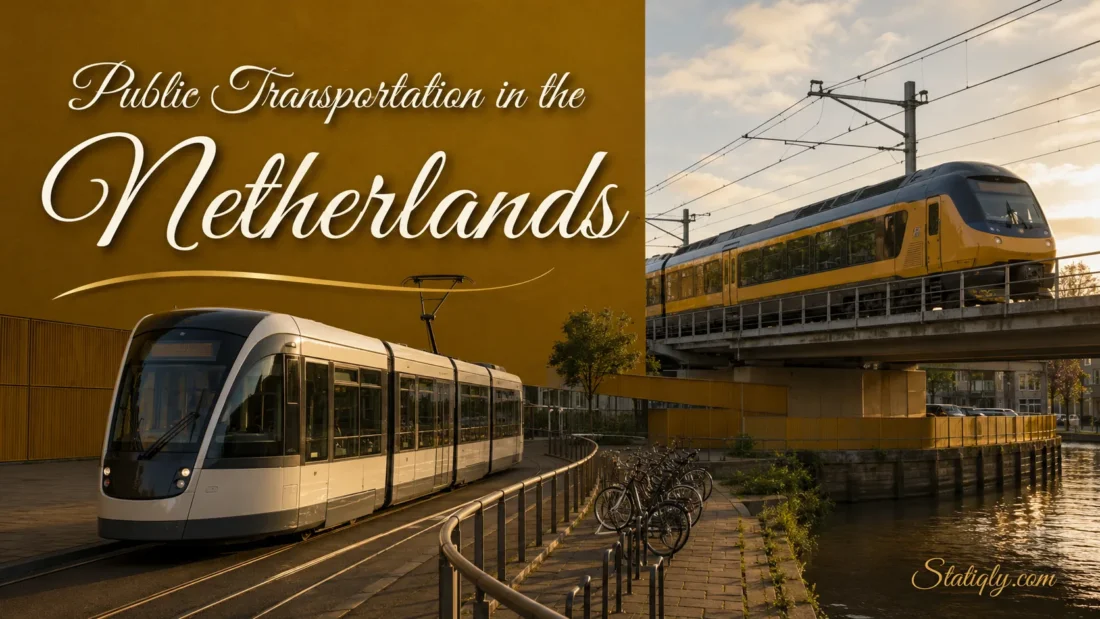
Public transportation in the Netherlands connects large cities, smaller towns, airports, coastal communities, and rural areas through an integrated network of trains, buses, trams, metros, and ferries. A journey may involve several operators, yet one travel planner and a single contactless payment method can cover most of the route. For occasional passengers, travelling can be as simple as tapping a bank card when boarding and tapping the same card again at the destination.
The railway forms the backbone of longer journeys. Local buses and urban rail systems handle the remaining distance. This combination makes it practical to stay in one city, travel between several Dutch regions, or reach a smaller place without hiring a car.
There is one habit every passenger needs to remember: check in at the beginning and check out at the end. Changing operators may require an extra check-out and check-in between services.
How The Network Fits Together
| Transport Type | Most Useful For | Where It Operates | Typical Payment |
|---|---|---|---|
| Intercity train | Travel between major cities | National rail network | OVpay, OV-pas, OV-chipkaart, or train ticket |
| Sprinter train | Shorter journeys and smaller stations | National and regional routes | OVpay, OV-pas, OV-chipkaart, or train ticket |
| Regional train | Provincial cities and local rail corridors | Selected routes outside the main NS network | Most national payment methods |
| Metro | Fast urban and suburban travel | Amsterdam, Rotterdam, and connections into The Hague | Contactless check-in and check-out |
| Tram | City centres and nearby districts | Amsterdam, Rotterdam, The Hague, and Utrecht | Contactless payment or local ticket |
| Bus | Urban districts, villages, and rural areas | Throughout the country | Contactless payment or operator ticket |
| Ferry or Waterbus | Crossing waterways and reaching waterfront communities | Amsterdam, Rotterdam, Dordrecht, and other water routes | Free on some crossings; ticket or OVpay on others |
The modes do not compete for the same job. They connect like parts of one route. A train may carry a passenger from Utrecht to Rotterdam, followed by a metro ride and a short walk. In a smaller province, the final section may use a regional bus instead.
Planning A Journey
Using The 9292 Planner
9292 plans journeys across Dutch trains, buses, trams, metros, and many ferry services. Enter an address, station, landmark, or postal code. The result normally shows:
- Walking directions to the first stop
- Departure and arrival times
- Platform or stop numbers
- Each required transfer
- The operators serving the journey
- Live changes where data is available
- An estimated fare
- Accessible travel options
This is usually the most practical planner for a journey that mixes several forms of transport. It can also show the live position of many trains, buses, trams, and metros.
Using The NS App
The NS app focuses on rail travel. It displays platform information, train length, transfers, planned maintenance, current service changes, and available onboard facilities. E-tickets purchased through NS can also be stored in the app.
Check the journey again shortly before leaving. Timetables are dependable, but platform assignments and connections can change during engineering work or busy travel periods.
Choosing A Payment Method
Contactless Bank Card, Credit Card, or Device
OVpay allows passengers to check in and out with a compatible contactless debit card, credit card, phone, or smartwatch. No Dutch bank account is required for most ordinary domestic journeys.
- Use the same physical card or device at both ends of the journey.
- One payment card or device can check in only one passenger at a time.
- Take the chosen card out of a wallet to prevent another contactless card from being read.
- A bank card stored on a phone may have a different digital identity from the physical card. Do not switch between them during the journey.
- Contactless train travel normally charges a full-fare, second-class journey unless a suitable discount product has been added.
For a visitor making occasional trips, OVpay removes the need to buy a transport card or load credit. The travel charge usually appears later on the linked bank account with an NLOV payment reference.
The New OV-pas
The OV-pas is replacing the OV-chipkaart alongside contactless bank-card travel. It works across Dutch train, bus, tram, and metro operators. Passengers can add credit and manage the card through an OVpay account.
Not every subscription and specialist travel product has completed the move to the new card. Regular passengers should check whether their preferred subscription can already be placed on an OV-pas before changing cards.
The OV-chipkaart During The Transition
The familiar OV-chipkaart continues to work for now. Personal cards may hold subscriptions, age-related products, automatic credit loading, and services such as OV-fiets rental. Anonymous cards can be shared between people at different times, but never during the same journey.
Anyone who already has a working OV-chipkaart does not need to stop using it immediately. New passengers should compare the OV-pas and OVpay options before buying an older card.
E-Tickets and Local Travel Products
NS sells mobile and printable rail tickets. An NS e-ticket does not require a normal card check-in. Its barcode opens compatible station gates and must remain available until the passenger leaves the destination station.
Cities also sell hourly, daily, and multi-day products. Read the coverage carefully. A ticket carrying the name of one urban operator may exclude national trains and regional buses, even when those services run through the same city.
How Checking In and Out Works
A Simple Tap Sequence
- Choose one card, phone, watch, transport pass, or valid ticket.
- Hold it against the reader before boarding or entering the paid area.
- Wait for the confirmation sound or message.
- Complete the journey.
- Check out with exactly the same method.
- Confirm that the reader shows a successful check-out.
On buses and trams, readers are normally inside the vehicle. Passengers check in after boarding and check out before stepping off. Metro and train readers may stand beside an open entrance or form part of a station gate.
Transfers Between Services
| Transfer | What To Do |
|---|---|
| NS train to another NS train | Remain checked in unless the route requires leaving the gated area |
| Train to a different rail operator | Check out with the first operator and check in with the next |
| Train to bus, tram, or metro | Check out of the train and check in again for the new mode |
| Bus or tram to another vehicle | Check out when leaving and check in after boarding the next service |
| Metro connection inside one operator’s paid area | Stay checked in until the exit unless signs direct otherwise |
Rail stations served by more than one company can have different sets of readers. Look at the operator name above or beside the reader. NS readers are yellow. Checking out at one company’s reader and accidentally checking back in with the same company does not start the intended connection.
Missed check-ins and check-outs can often be corrected through the OVpay app, the card account, or the operator’s customer service system. Deal with an incomplete journey soon after noticing it.
Train Travel Between Dutch Cities
Intercity and Sprinter Trains
Intercity trains serve medium and long routes and stop mainly at larger stations. They suit journeys such as Amsterdam to Utrecht, The Hague to Eindhoven, or Rotterdam to Groningen. Intercity trains have first- and second-class sections, toilets, and designated quiet areas.
Sprinter trains stop at most or all stations on their route. They work well for shorter trips, suburban destinations, and places skipped by an Intercity. Their wide doors help passengers board and leave quickly.
A Sprinter is not automatically the slower choice for every journey. If the destination is a small station, it may provide a direct connection while an Intercity requires a transfer.
National and Regional Rail Operators
Nederlandse Spoorwegen (NS) operates much of the passenger rail network. Arriva, Qbuzz, Keolis, Connexxion, Breng, and other regional companies run selected routes. National planners include these services, so passengers do not need separate route searches.
The operator matters at check-in points. When a journey changes from an NS train to a regional train company, use the readers belonging to both operators: first out, then in.
First Class, Second Class, and Supplements
Train compartments display a large 1 or 2 inside and outside. Ordinary contactless bank-card travel uses second class. A first-class ticket or activated first-class product is needed for seats marked with 1.
Some faster services or particular domestic sections require a supplement. Examples may include Intercity Direct, Eurocity Direct, or ICE services, depending on the route and ticket. The NS planner identifies connections where an additional payment applies.
Peak Periods and Night Trains
NS off-peak hours normally run on weekdays from 9:00 a.m. to 4:00 p.m. and from 6:30 p.m. to 6:30 a.m. Weekends count as off-peak throughout the day. These times affect selected discount products; they do not give every contactless passenger an automatic discount.
Night trains run every night on the main Randstad circuit linking Rotterdam, The Hague, Leiden, Schiphol Airport, Amsterdam, and Utrecht. Selected routes beyond this area receive weekend night or extra-late services. Outside those corridors, the final train may leave much earlier. Always check the date and planned arrival time.
Urban and Regional Transportation
| Area | Main Local Modes | Common Operator | Network Character |
|---|---|---|---|
| Amsterdam | Tram, metro, bus, ferry | GVB | Dense city network with five metro lines and IJ crossings |
| Rotterdam | Metro, tram, bus | RET | Wide metro network extending into nearby municipalities |
| The Hague | Tram, light rail, bus | HTM | Urban trams with regional links to Delft and Zoetermeer |
| Utrecht | Tram and bus | U-OV | Routes centred on Utrecht Centraal and surrounding districts |
| Other Regions | Bus and regional train | Varies by province | Connections between stations, towns, villages, and rural stops |
Buses
City buses stop frequently, while regional buses cover longer distances between stations, towns, and villages. Some lightly used routes operate only after a reservation. The planner labels these as demand-responsive transport or a reservation service.
At a roadside stop, make it clear that you intend to board. Check the line number and destination on the front of the bus. Press the stop button before the required stop, then check out at the reader near the door.
Trams, Metros, and RandstadRail
Trams are well suited to central districts because stops sit close to shops, residential streets, museums, and railway stations. Metros cover longer urban distances with fewer interruptions.
The Hague and Rotterdam are linked through RandstadRail. HTM light-rail routes connect The Hague with Zoetermeer, while RET metro line E links The Hague Centraal with Rotterdam. Operator names and line numbers matter more than vehicle colour when choosing where to check in.
Ferries and Water Transport
Most GVB ferry crossings over the IJ in Amsterdam are free for pedestrians and cyclists. They leave from waterfront points including the area behind Amsterdam Centraal. Since no payment is needed on a free crossing, passengers simply follow the boarding signs.
Waterbus routes around Rotterdam and Dordrecht use fares and accept OVpay. Other ferries, including services to the Dutch islands, may have their own reservation and ticket systems. A national contactless transport card should not be assumed valid on every boat.
Public Transportation From Schiphol Airport
Schiphol Airport railway station sits directly below the terminal. Escalators and lifts connect Schiphol Plaza with the platforms. Direct trains serve Amsterdam, Utrecht, Leiden, The Hague, Delft, Rotterdam, and several other cities.
The train readers stand upstairs near the entrances to the platform area rather than beside the trains. Check in before taking the escalator or lift down. Passengers using an NS e-ticket scan its barcode at a suitable gate instead.
Buses leave from stops outside Schiphol Plaza and serve Amsterdam districts, Haarlem, Leiden, nearby towns, and hotels. Train travel generally suits city-centre and intercity destinations; buses can be more direct for places away from a railway station.
Combining Public Transport With A Bicycle
Taking A Bicycle On The Train
A regular bicycle needs a separate off-peak bicycle ticket. On weekdays, bicycles are normally allowed from 9:00 a.m. to 4:00 p.m. and from 6:30 p.m. to 6:30 a.m. They are allowed throughout most weekends, recognised public holidays, July, and August, subject to space.
- Use doors marked with a bicycle symbol.
- Place the bicycle only in a designated area.
- Remove bags from the bicycle after boarding.
- Allow time for another train if all bicycle spaces are occupied.
- Check separate conditions for international trains and replacement buses.
A fully folded bicycle smaller than 45 × 86 × 80 centimetres can normally travel free as hand luggage throughout the day. It should be folded before boarding and kept away from doors and aisles.
Renting An OV-fiets
OV-fiets rental locations are available at more than 300 stations and transport hubs. They solve the final-distance problem without taking a bicycle on the train. The NS app shows availability at participating locations.
Rental requires an eligible personal transport card or account with the necessary OV-fiets or NS Flex product. A visitor cannot normally unlock an OV-fiets by tapping an unrelated foreign bank card. Check eligibility before making the bicycle part of a planned route.
Accessible Travel and Passenger Facilities
The 9292 planner includes an accessible journey option that considers available information about vehicles, stations, and stops. The NS planner can also identify accessible train journeys and provide access to travel-assistance booking.
- Many stations have lifts, ramps, tactile guidance lines, and wider gates.
- Newer Sprinter and ICNG trains have retractable steps for easier boarding at suitable platforms.
- Most buses have low floors and a designated wheelchair position.
- Accessibility differs between tram models and individual stops.
- Visual screens and spoken announcements identify upcoming stops on most services.
- Wheelchairs, walkers, and crutches can generally be carried without an extra transport charge.
Do not rely only on the accessibility of the vehicle. A lift, platform, or street-level stop can affect the whole route. Check the exact journey and request NS travel assistance where independent boarding is not suitable.
Prams and ordinary luggage are accepted when they do not block doors, aisles, or wheelchair spaces. On trains, luggage should remain within reach and must not occupy a seat when another passenger needs it.
Matching The Ticket To The Journey
| Travel Pattern | Practical Choice | What To Confirm |
|---|---|---|
| One or two ordinary journeys | OVpay with a contactless card or device | Card compatibility and sufficient funds |
| Rail journey bought in advance | NS mobile or printed e-ticket | Correct name, date, route, and travel class |
| Frequent trips within one city | Operator day or multi-day ticket | Included lines and excluded operators |
| Several cities in one day | National or multi-operator travel product | Peak-time restrictions and operator coverage |
| Regular travel over several weeks | OV-pas or personal card with a subscription | Whether the product has moved to OVpay |
| Train followed by bicycle rental | Eligible personal card with OV-fiets access | Rental availability at the destination |
A city ticket is not automatically a national ticket. For example, a GVB product may cover GVB trams, buses, metros, and specified ferries in Amsterdam while excluding an NS train through the city. Tourist products sometimes combine airport and urban transport, but their exact operator list must still be checked.
Common Errors That Lead To Extra Charges
- Checking in with a physical bank card and checking out with the same card stored on a phone
- Leaving a bus or tram without checking out
- Using the wrong rail operator’s reader during a transfer
- Assuming one contactless card can check in several passengers
- Entering first class with a second-class contactless journey
- Buying an urban day ticket that excludes the required regional operator
- Scanning an NS e-ticket as though it were an OVpay card
- Expecting a regular bicycle to travel during weekday peak periods
- Relying on cash when an operator accepts only cards or digital payments
Dutch Words Seen During A Journey
| Dutch Term | English Meaning |
|---|---|
| Spoor | Track or platform number |
| Halte | Bus or tram stop |
| Richting | Direction or destination |
| Vertrek | Departure |
| Aankomst | Arrival |
| Overstappen | Change or transfer |
| Inchecken | Check in |
| Uitchecken | Check out |
| Ingang | Entrance |
| Uitgang | Exit |
| Vertraging | Delay |
| Niet Instappen | Do not board |
Questions Passengers Often Ask
Can A Visitor Use A Foreign Contactless Bank Card?
Compatible foreign debit and credit cards generally work with OVpay. Check that contactless payments and overseas transactions are enabled. Keep another accepted payment method available in case the card issuer blocks the transaction.
Does Every Passenger Need A Separate Card?
Yes. Each passenger needs a separate card, device, pass, or ticket. A parent cannot check in several people by tapping one bank card repeatedly.
Is A Check-Out Required When Changing Trains?
Not when changing between trains operated by the same company inside the station. A change to another rail operator usually requires checking out with the first company and checking in with the second.
Can Public Transportation Be Paid For With Cash?
Cash acceptance is limited. Many buses, trams, machines, and service points use card-only payment. Contactless payment or a ticket purchased in advance is more dependable.
Does Public Transportation Run All Night?
Only on selected routes. The Randstad has an overnight rail circuit, and some cities operate night buses. Smaller cities and regional routes may stop before midnight. Plan the complete return journey rather than assuming the daytime service continues overnight.
Is A Reservation Needed For Domestic Trains?
Ordinary domestic NS and regional trains do not use seat reservations. A valid check-in or ticket is enough. International trains, special products, bicycles on certain international services, and demand-responsive buses can follow different rules.