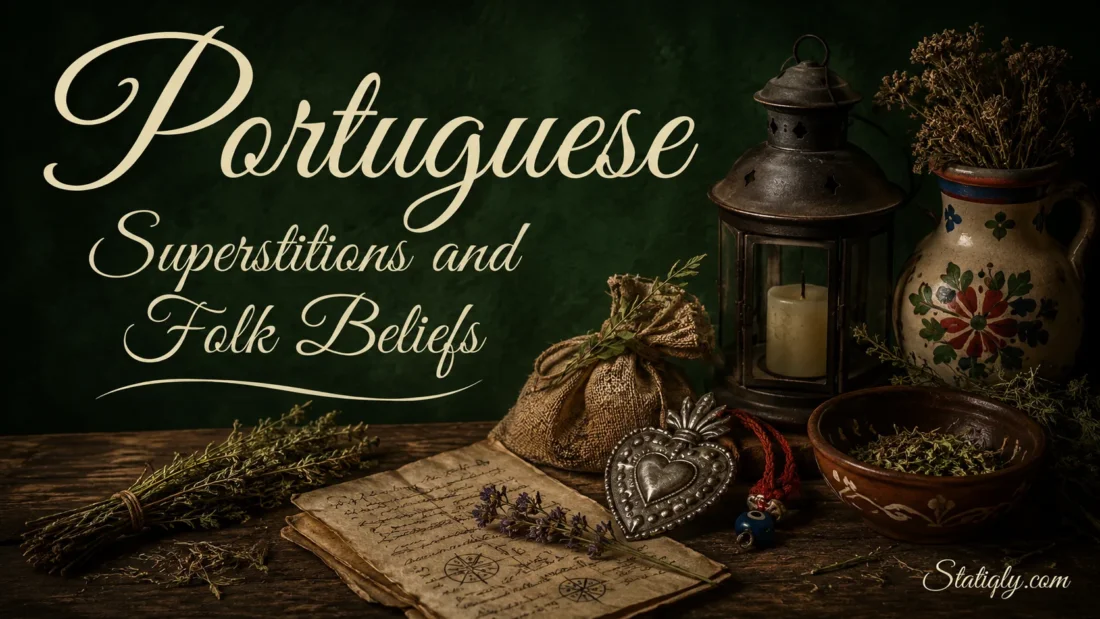
Portuguese superstitions and folk beliefs are small windows into everyday life: the way people protect a home, greet a baby, respect bread, read a lucky sign, or explain a strange moment at the dinner table. Many of these beliefs are not formal rules. They live in family sayings, village habits, festival stories, and quiet gestures passed from one generation to the next. Some people follow them closely. Others smile and keep them as part of cultural memory. Either way, they tell us something warm and human about Portugal.
A Grounded Look At Common Portuguese Folk Beliefs
The table below brings together well-known examples in a careful way. The aim is not to claim that every Portuguese person believes the same thing. Folk belief changes by region, family, age, and setting. A belief can be strong in one home and barely known in another.
| Belief Or Custom | Portuguese Term Or Common Name | Usual Meaning | Where It Often Appears |
|---|---|---|---|
| Evil eye protection | Mau-Olhado | A way to guard against envy or unwanted negative attention | Family talk, baby care, charms, everyday caution |
| Fig hand amulet | Figa | A small protective charm, often linked with luck and protection | Jewelry, keepsakes, older household customs |
| Respecting bread | Bread Not Placed Upside Down | A sign of respect for food and household blessing | Kitchen tables, family meals, older sayings |
| Good-luck rooster | Galo De Barcelos | A symbol tied to luck, justice, and a famous legend from Barcelos | Souvenirs, home decor, cultural symbols |
| Saint Anthony help | Santo António | Associated with matchmaking, small favors, and local devotion | June festivities, Lisbon traditions, family stories |
| Burning ears | Orelhas A Arder | A playful sign that someone may be talking about you | Daily speech, teasing, informal conversation |
| Lucky horseshoe | Ferradura | A common protective sign for good fortune | Doorways, rural homes, decorative objects |
Why These Beliefs Still Feel Familiar
Folk beliefs often survive because they are easy to remember. A rooster, a piece of bread, a small hand-shaped charm, a salt gesture, a saint’s name. Simple objects carry meaning. That is why they travel so well through families.
In Portugal, many popular beliefs grew around the home, the table, the street, the church calendar, farming life, seafaring memory, and regional storytelling. Not all of them are practiced today in the same way. Some now feel more like cultural phrases than active belief. Still, they remain part of the country’s social texture.
Small signs matter in folk culture. A charm on a baby bracelet. A rooster on a shelf. Bread turned the right way on the table. Tiny acts, yes. But tiny acts can carry a family’s sense of care.
Mau-Olhado: The Portuguese Evil Eye Belief
Mau-olhado means the evil eye. In Portuguese folk belief, it refers to harm or discomfort thought to come from envy, too much admiration, or an intense look. The idea is known in many cultures, but Portugal gives it its own language, gestures, and family habits.
The belief often appears around babies, health, beauty, success, and moments when someone receives praise. A parent or grandparent might be careful about strong compliments, especially toward a child. The thought is simple: too much attention can feel heavy.
How People Traditionally Respond To Mau-Olhado
- They may use a small protective charm.
- They may avoid overly intense praise without a softening phrase.
- They may keep certain family sayings or gestures private.
- They may treat the belief as a symbol of care rather than fear.
For a visitor, this belief is best read with respect. It is not a tourist trick. It is part of how some families talk about protection, modesty, and affection. Quietly held, often.
The Figa: A Small Charm With A Long Memory
The figa is a hand-shaped amulet, usually shown with the thumb tucked between the fingers. In Portuguese and wider Mediterranean folk practice, it is linked with protection and good luck. It may appear as a pendant, bracelet charm, keyring, or small keepsake.
Its meaning depends on context. In a family setting, it can be a protective gift. In a shop, it may be sold as a cultural object. In an older household, it may sit among other small items that carry memory: medals, shells, rosaries, dried plants, or inherited jewelry.
The figa is interesting because it is both tiny and bold. It fits in a pocket, yet it speaks the language of protection. Like a little lock on a door.
Bread On The Table: Respect In A Daily Object
One of the most familiar Portuguese food-related beliefs says that bread should not be placed upside down on the table. For many people, this is less about fear and more about respect. Bread has long stood for work, food, blessing, and shared meals.
A loaf may look ordinary, but on a Portuguese table it can carry deep feeling. It belongs beside soup, cheese, olives, fish, stews, and family talk. Turning it the right way can feel like a quiet act of gratitude.
What This Belief Tells Us
- Food is treated as something worthy of care.
- Household habits can hold moral meaning.
- A small table rule can carry family identity.
- Respect often appears through simple gestures.
Galo De Barcelos: Luck, Justice, And A Famous Rooster
The Galo de Barcelos, or Barcelos Rooster, is one of Portugal’s best-known folk symbols. Its story is tied to the northern city of Barcelos and to a legend about a rooster that helped reveal truth at the right moment.
The short version is easy to remember: a traveler was accused unfairly, and a rooster became part of the sign that cleared his name. The tale has variations, as folk stories often do. That is normal. Oral tradition changes shape as it moves from voice to voice.
Today, the rooster appears on ceramic pieces, souvenirs, tiles, home objects, and cultural displays. Many people connect it with good luck, honesty, and hope. Bright colors help it stand out, but the story gives it weight.
Why The Rooster Works As A Folk Symbol
- It is easy to recognize.
- It links one city to a national image.
- It carries a moral story without needing a long explanation.
- It turns a local legend into a friendly cultural emblem.
Saint Anthony And Everyday Folk Hope
Santo António, known in English as Saint Anthony, holds a special place in Portuguese popular devotion. Lisbon celebrates him strongly in June, and many stories link him with love, marriage, lost things, and small personal hopes.
This area sits between religion, local celebration, and folk custom. Some people pray. Some enjoy the festive side. Some keep old family sayings. The same name can carry different meanings depending on the person speaking.
In folk belief, saints often act like familiar helpers. Not distant figures, not abstract ideas. More like a trusted neighbor whose name enters daily life.
Burning Ears And Social Guesswork
A playful belief says that if your ears are burning, someone may be talking about you. Many cultures have a version of this. In Portuguese conversation, it can appear as light teasing, not a formal belief.
The charm of this saying lies in how ordinary it is. The body feels something, and the mind turns it into a social story. Who is speaking? Is it praise? Is it gossip? The belief adds a little theatre to daily life.
Salt, Doors, And Household Protection
Salt has a strong place in many folk traditions because it protects food, cleans, preserves, and marks the table. In Portuguese household belief, salt may appear in sayings about luck, care, and protection. The details vary, so it is better to speak gently rather than treat one version as universal.
Doorways also matter in folk thinking. A door is more than wood and metal. It is a line between inside and outside. That is why protective signs, horseshoes, blessed items, or small charms may be linked with entrances in older customs.
The idea is not hard to understand. A home is a safe place. People mark safe places.
Regional Variety Across Portugal
Portugal is small on a map, but its folk culture is not flat. Northern villages, Alentejo towns, coastal communities, Madeira, the Azores, and Lisbon neighborhoods can keep different sayings and habits. Even two families on the same street may remember a belief in different words.
Some customs connect to farming seasons. Others connect to fishing life, Catholic feast days, local legends, food habits, or family protection. Folk belief works like a patchwork blanket: each square has its own pattern, but the whole thing still feels connected.
Common Places Where Folk Beliefs Appear
- Family meals: bread, salt, table manners, blessings, and sayings.
- Childhood care: protection from envy, charms, and careful praise.
- Festivals: saints, local legends, music, food, and symbolic objects.
- Home entrances: protective objects near doors or thresholds.
- Daily speech: short phrases about luck, signs, and strange feelings.
Belief, Custom, And Cultural Memory
Not every superstition is believed literally. That point matters. A person may avoid turning bread upside down because their grandmother taught them so, not because they expect anything bad to happen. A rooster may be kept for beauty, luck, nostalgia, or all three at once.
Folk belief often works this way. It does not need full agreement. It only needs memory. A saying stays alive because someone repeats it at the right moment. A charm stays in use because someone gives it with love.
There is a soft lesson here: culture is not only found in monuments and museums. Sometimes it sits near the bread basket.
How Visitors Can Read Portuguese Superstitions Respectfully
Portuguese folk beliefs should be approached as cultural details, not as jokes or strange habits. A visitor does not need to believe in them to respect them. Listening is enough.
- Notice the setting before asking questions.
- Treat family customs as personal, not public performance.
- Avoid mocking beliefs linked with babies, food, home, or faith.
- Remember that regional versions may differ.
- Use simple curiosity: “What does that mean in your family?”
That last question opens the right door. It lets the person explain the belief in their own words.
Portuguese Words Often Linked With Folk Belief
| Portuguese Word Or Phrase | Simple English Meaning | Cultural Use |
|---|---|---|
| Mau-Olhado | Evil eye | Used for envy, harmful attention, or protective talk |
| Figa | Fig hand charm | A protective amulet or lucky object |
| Galo De Barcelos | Barcelos Rooster | A folk symbol of luck, truth, and cultural identity |
| Santo António | Saint Anthony | Linked with popular devotion, love customs, and June festivities |
| Ferradura | Horseshoe | Often linked with good luck and protection |
| Orelhas A Arder | Burning ears | A light saying about someone talking about you |
What These Beliefs Reveal About Daily Life
Portuguese superstitions often circle around care. Care for children. Care for food. Care for the home. Care for reputation, luck, health, and small hopes. They may sound playful, but many grew from serious parts of daily life.
That is why the best way to read them is not as a list of odd rules. Read them as social clues. They show what people wanted to protect.
A baby receives a charm. Bread is placed with respect. A rooster stands for a story people still remember. An ear burns, and someone laughs. Culture moves through these little moments, quietly but clearly.
Common Questions About Portuguese Superstitions
Do Portuguese People Still Believe In Superstitions?
Some do, some do not. Many people keep certain customs as family habits, cultural memory, or playful sayings. Belief can be literal, symbolic, or simply affectionate.
Is Mau-Olhado Unique To Portugal?
No. The evil eye appears in many cultures. Portugal has its own words, habits, and protective objects connected with the idea.
Why Is The Barcelos Rooster Linked With Luck?
The Barcelos Rooster comes from a famous folk legend about truth and a surprising sign. Over time, the rooster became a widely recognized Portuguese symbol connected with good fortune, honesty, and cultural pride.
Why Should Bread Not Be Placed Upside Down?
In many Portuguese homes, this belief reflects respect for bread and food. People may not treat it as a strict rule today, but the gesture still carries family meaning.
Are These Beliefs The Same Across Portugal?
No. Folk beliefs change by region, family, and generation. The north, south, islands, rural areas, and cities can preserve different versions of the same idea.