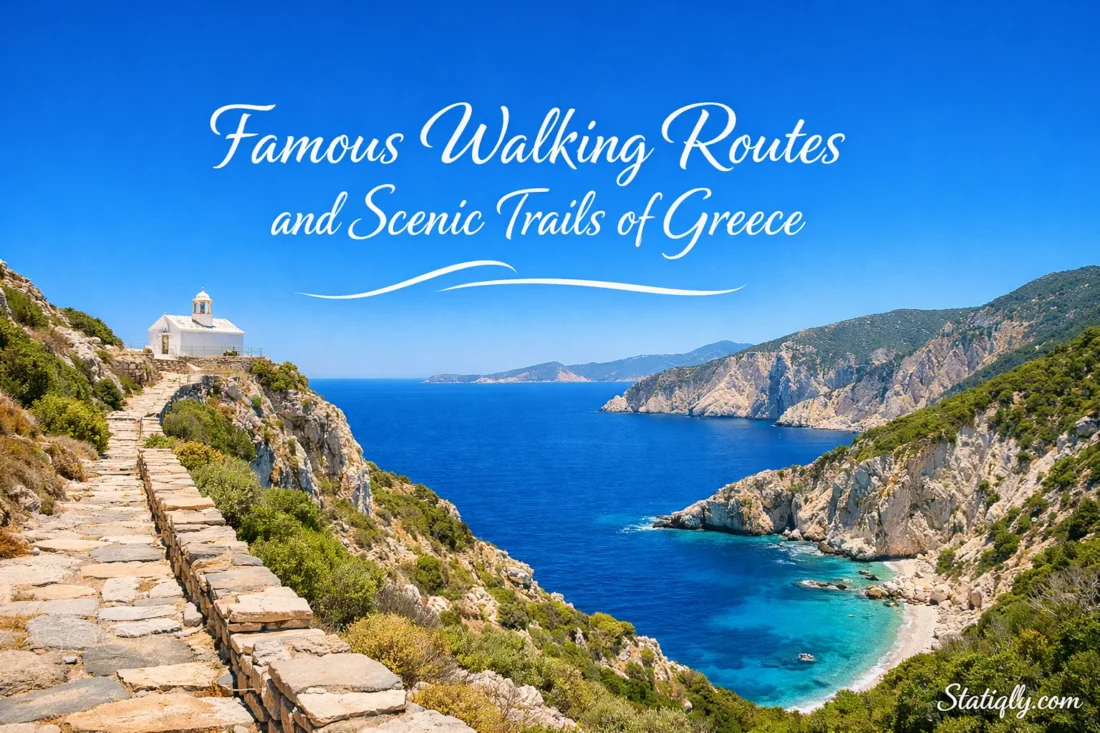
Greece makes walking feel personal. On one trail, you move through olive groves and quiet coves. On another, you climb into stone villages, cross old mule paths, and look down into a gorge that seems cut with a knife. That range is what sets the country apart. You are never choosing only between “mountain” and “sea”. Often, you get both in the same day. For travelers who like to understand a place step by step, Greece’s walking routes offer some of the clearest, most rewarding ways to do it.
Routes That Show Greece Best on Foot
| Route | Area | Typical Length | Walking Style | Why It Stays With People |
|---|---|---|---|---|
| Corfu Trail | Corfu | About 180 km | Multi-day island crossing | Beaches, olive country, villages, and a wilder north |
| Menalon Trail | Arcadia, Peloponnese | 75 km | 8 village-to-village sections | Stone settlements, mountain paths, and a very walkable base area |
| Andros Route | Andros | 100 km | 10 daily sections | Cycladic views mixed with springs, terraces, and old paved paths |
| Samaria Gorge | Crete | About 16 km | One-way full-day walk | Long descent through a famous gorge to the Libyan Sea |
| Vikos Gorge Trail | Zagori, Epirus | 12.5 km | Full-day one-way hike | High cliffs, river scenery, and a strong mountain feel |
| Fira to Oia Caldera Trail | Santorini | 10.5 km | Half-day scenic walk | Caldera views, white villages, chapels, and sunset timing |
| Long Pelion Trail | Pelion | 168 km | 11 daily sections | Forest, coast, rail history, and village life in one long line |
Why Greek Trails Feel Different
Part of it is geography. Greece folds quickly. A coastal path can rise into a ridge before lunch. A mountain trail can end near a harbor. But the bigger reason is older than tourism. Many of these routes follow kalderimia, the stone footpaths once used to link villages, fields, chapels, mills, and ports. You do not just walk through scenery here. You walk through the old shape of daily life.
- Island routes tend to mix sea views with village stops and dry, open terrain.
- Mainland routes often feel greener, deeper, and more layered, with rivers, forests, and stone bridges.
- Village-to-village trails suit travelers who want a steady rhythm: walk, arrive, eat, sleep, repeat.
- Gorge walks give you the most dramatic scenery, but they ask more from your legs and your timing.
Trails Worth Planning Around
Corfu Trail
The Corfu Trail is one of those routes that changes character as you go. In the south, the ground is gentler and more open. You pass beaches, farmland, and lower hills. Move farther north and the island tightens up: the terrain gets steeper, the views widen, and the walking starts to feel more rugged. That shift is part of the appeal. The trail gives you a full island story instead of a single postcard angle.
It also shows a side of Corfu that many short stays miss. Beyond the famous shoreline, there is a web of rural lanes, olive groves, cobbled stretches, monastery stops, and smaller settlements where the pace drops almost at once. The route works well for walkers who want a long island journey rather than isolated day hikes. Not flashy. Very satisfying.
- Good Match For: Travelers who want one route with sea, countryside, and mountain sections.
- What the Walking Feels Like: Mixed terrain, long days, steady variety.
- What Stands Out: You can feel the island changing under your feet from south to north.
Menalon Trail in Arcadia
Menalon Trail is a very strong choice for people who like structure. It runs for 75 km in 8 sections and links Arcadian villages such as Stemnitsa, Dimitsana, Vytina, Nymphasia, and Lagkadia. That layout matters. Each section feels like a real walking day, and the village chain gives the route a natural rhythm that is easy to plan around.
Scenery here is not harsh or empty. It is textured. Forest edges, river gorges, mountain slopes, old stone lanes, and settled places appear in turns, not all at once. The result is a route that feels balanced. You get mountain walking, yes, but you also get dinners in village squares, a bed nearby, and a sense that the trail belongs to the region rather than sitting apart from it. For many walkers, that makes all the difference.
- Good Match For: People who want a well-defined multi-day route with overnight stops in villages.
- What the Walking Feels Like: Mountain walking with a lived-in human scale.
- What Stands Out: The route is tidy, legible, and easy to break into sections.
Andros Route
Many people picture the Cyclades as bright, dry, and almost bare. Andros Route quietly changes that picture. Yes, you still get the open Aegean light and the clean lines of island landscapes. But Andros also gives you springs, terraces, ravines, old bridges, and stretches of stone path that feel older than the modern road system by a long way.
The full route runs north to south across the island for 100 km and can be walked in daily sections. This is where Andros becomes special: it does not read like a single coastal walk. It reads like a cross-section of the island itself. One part feels agricultural, another feels almost alpine, then suddenly the sea comes back into view. For walkers who want a Cycladic trail with more depth under the surface, this is one of the smartest picks in Greece.
- Good Match For: Walkers who like island scenery but want more greenery and path heritage.
- What the Walking Feels Like: Varied, layered, and often quieter than people expect.
- What Stands Out: The route shows that a Cycladic island can be both dry and lush, open and sheltered.
Samaria Gorge in Crete
Samaria Gorge is one of the best-known walks in Greece for a reason. The route is long enough to feel like a proper day out and dramatic enough to stay in your head after it is done. You descend from Xyloskalo through the gorge, move across rocky ground and river crossings, and continue toward Agia Roumeli by the sea. It is not a casual stroll, even though many travelers take it on.
What makes Samaria memorable is not only scale. It is movement. You start high, pass through changing rock walls and narrower sections, and finish with salt in the air. Few Greek walks give that kind of top-to-bottom shift in a single line. The trail suits travelers who want a single, big walking day rather than a multi-day trip.
- Good Match For: Visitors based in Crete who want one famous full-day hike.
- What the Walking Feels Like: Long descent, rocky surface, steady effort over many hours.
- What Stands Out: The finish near the sea gives the route a clean, satisfying arc.
Vikos Gorge in Zagori
Vikos Gorge belongs to a different mood. Samaria feels broad and public. Vikos feels deeper, quieter, and more mountain-bound. The route is about 12.5 km, usually taking a full walking day, and it threads through one of the strongest natural landscapes on the Greek mainland. This is not the Greece of whitewashed terraces and harbor light. This is cliff country, river country, stone-village country.
Zagori adds to the pull. You are not just walking a gorge; you are entering a whole upland region known for its villages, bridges, and viewpoints. Some travelers come mainly for the big panorama from places like Oxia or Beloi. Others want the full trail experience. Both make sense. Still, the real pleasure comes when the route and the wider landscape connect in your mind. Then it clicks.
- Good Match For: Walkers who prefer mainland mountain scenery and a stronger wilderness feel.
- What the Walking Feels Like: Full-day, scenic, and more demanding than the distance may suggest.
- What Stands Out: The gorge and the villages around it belong to the same landscape story.
Fira to Oia Caldera Trail
The Fira to Oia Caldera Trail is proof that a shorter route can still feel complete. At 10.5 km, it is far more manageable than the long-distance trails above, yet it delivers one of the clearest walking identities in Greece. You move along the caldera edge, pass through Firostefani and Imerovigli, see chapels and cliffside settlements, and keep the sea in view almost the entire time.
This walk suits travelers who are not building a whole trip around trekking but still want a proper trail experience. The route is scenic from start to finish, but timing matters. Early morning feels cleaner and calmer. Late afternoon can turn the walk into a sunset route. The ground is mixed, with paved stretches, cobbles, and rougher parts, so it still feels like a trail, not just a promenade.
- Good Match For: Travelers who want a half-day walk with very high scenery return.
- What the Walking Feels Like: Open views, frequent photo pauses, some steps and uneven ground.
- What Stands Out: Few short Greek trails link villages and views this neatly.
Long Pelion Trail
Long Pelion Trail gives you a different type of scale. At 168 km over 11 daily sections, it is a long route, but not a monotonous one. Pelion is full of shifts: chestnut woods, village squares, ridges, sea-facing slopes, old monasteries, coastal segments, and path systems tied to the mountain’s old settlements. One day can feel inland and shaded. The next can open toward the coast.
That mix makes Pelion appealing to walkers who want length without sameness. There is also a cultural texture here that runs deep, with villages, rail history, arches, cobbled connections, and local walking traditions layered into the route. In plain terms, this is a trail for people who enjoy staying with a place rather than sampling it once and moving on.
- Good Match For: Experienced walkers planning a longer route with changing terrain.
- What the Walking Feels Like: Long stages, many landscape shifts, and a strong village presence.
- What Stands Out: Forest and coast sit unusually close together here.
How to Choose the Right Trail
- Choose Corfu Trail when you want one island route that keeps changing as you move north.
- Choose Menalon Trail when you want a clean village-to-village setup with strong walking infrastructure.
- Choose Andros Route when you want Cycladic light without giving up springs, terraces, and old paths.
- Choose Samaria Gorge when one bold day hike in Crete is the main goal.
- Choose Vikos Gorge when cliffs, river scenery, and a stronger mountain atmosphere matter most.
- Choose Fira to Oia when you want a shorter scenic walk that fits a wider island trip.
- Choose Long Pelion Trail when you want a longer route with real variation from section to section.
Small Details That Matter on Greek Trails
Greek walking is often more comfortable in spring and early autumn, especially on exposed island trails. Mainland mountain routes can stay cooler for longer, but even there, an early start helps. Water, sun cover, and proper footwear are not optional extras here. They are part of the walk.
- Island trails usually feel better early in the day, before the ground reflects too much heat.
- Gorge walks need timing and transport planning, especially when the route is one-way.
- Village-based routes are often the easiest to spread across several days without rushing.
- Stone paths and cobbles look gentle from a distance, but they can be slippery, polished, or uneven.
- Marked long routes reward patience; rushing through them flattens the experience.
And that may be the real thread running through the best walks in Greece. They are not only scenic. They are paced in a human way. A chapel appears. A spring appears. A square, a bridge, a beach, a ravine. Then another bend. Keep walking, and the country keeps opening.